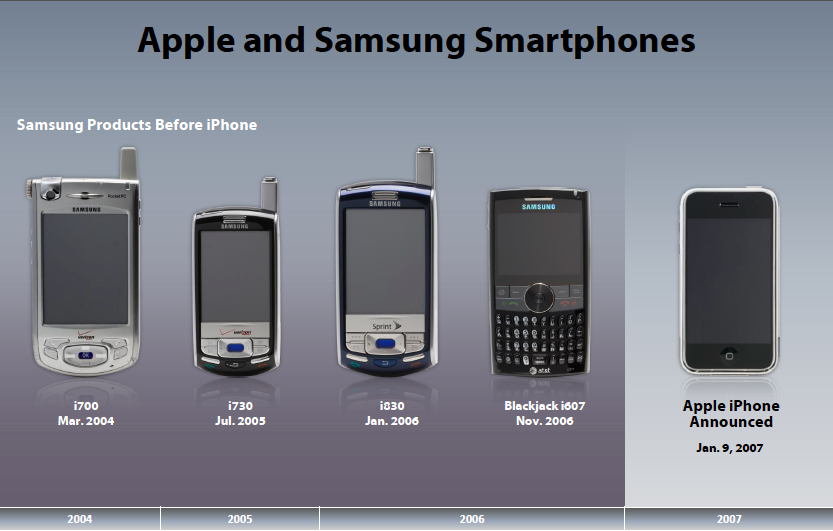
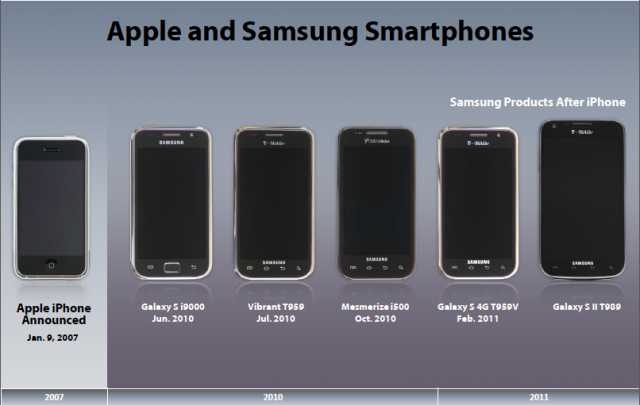
To everyone saying "these are basic phone designs," try and remember reactions to the original iPhone release keynote. The design was originally reasonably polarizing/radical. Half the reason these design elements are now so widespread is because everyone immediately copied Apple.
One of the Android engineers (back when Android was going to be a Blackberry knockoff) made a similar comment about his reaction to the iPhone unveiling.
>“As a consumer I was blown away. I wanted one immediately. But as a Google engineer, I thought ‘We’re going to have to start over.’”
What we had suddenly looked just so . . . nineties,” DeSalvo said. “It’s just one of those things that are obvious when you see it."
Lots of phones had touchscreens before. It was a combination of the physical design, engineering, UI and feature set that was so ground breaking. The thing is each of these things is intimately connected and depend on each other. You can’t just do one without the other three and have anything worthwhile. That’s why this was so hard.
It’s why analysts that just focuses on one obvious feature - a touch screen - misses the point so badly. If a touch screen was all that mattered, why didn’t the Android team copy one of the previous touch screen phones instead?
As someone who developed for Mobile Phones pre iPhone era, I can say they are people who never worked on software for Mobile before iPhone :).
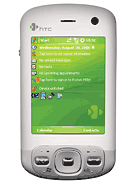
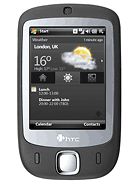
There were number of Phone that existed with several of those styles.
How many people know Verizon Had a decent app store (Apps developed with Brew) in US before iPhone? This included similar testing that you see for AppStore TODAY.
I've probably used more brew apps than play/appStore/etc combined since. Was a wonderfully useful store with generally high quality, useful, apps that we easy to find.
I think maybe he is talking about the general IDEA, not necessarily the look and feel. You're right in asserting that there really was nothing like iPhone before iPhone, but the IDEA was there from way back with HP Jornadas and the older BREW phones. (I do concede that the UI of all of those devices was, in PRACTICE, much different than the iPhone UI. That much is undeniable when you look at old pictures of them. Back then, basically they all tried to copy MS Windows in a small screen.)
But the general idea of the UI was what set the iPhone apart. Instead of using a stylus to simulate a mouse, it used your fingers and direct manipulation of the user interface. That was a huge conceptual change.
I used my fingers on my Palm Pilot because it was more practical than dragging the stylus out. It wasn't using fingers per se that was revolutionary with the iPhone but that it packaged everything up in a package that was actually attractive to "normal people" instead of only appealing to gadget geeks and power users the way things like Palm devices did.
> I used my fingers on my Palm Pilot because it was more practical than dragging the stylus out.
Still using it in the same way as a mouse. The thing that set the iOS UI apart is direct manipulation of the UI. E.g. instead of using a scrollbar/arrows to scroll, you use your finger to move the page around. Instead of clicking a checkbox you move a slider. Instead of clicking a "zoom in" button you 'stretch' the photo out using your fingers. etc.
That might be true for some interactions, but you touched icons, buttons etc., and frankly I don't think that part would have made that much of a difference for users.
It certainly wasn't something most potential users knew about the Palm Pilot before rejecting it out of hand as some gadget.
> I don't think that part would have made that much of a difference for users
I do. I think it was a revolutionary improvement. It's so much more intuitive to use, it's the one thing that makes your grandma able to use an iPad. It's hard to overstate how important this was. The fact that now you know about it, it seems obvious and not a big deal emphasises how big of an improvement it was.
> It certainly wasn't something most potential users knew about the Palm Pilot before rejecting it out of hand as some gadget.
Of course not, it wasn't invented yet so they didn't know the Palm Pilot lacked this.
> Of course not, it wasn't invented yet so they didn't know the Palm Pilot lacked this.
You miss the point: Most people rejected the Palm Pilot before seeing how you interacted with it at all. The idea that how you interact with the device makes such a big difference is flawed to a large extent because these devices demonstrated quite clearly that there were other issues that stopped mass market adoption of these devices before people even bothered to figure out how you actually interacted with them.
I developed for Windows Mobile before and slightly after the iPhone. Windows Mobile was slightly ahead of the iPhone as an app platform until around 2009.
Can you please elaborate on what made windows mobile better for apps? Why did Microsoft not want to continue this? I think windows mobile was a complete scratch and rewrite?
My understanding for why Google wanted Android and open handset alliance is the fragmentation of mobile at that time: it took too much effort to get Google maps on all these different J2ME (I think I got the name right) devices.
I had an early smartphone, the Sony Ericsson P800, and it was a full screen and the home page was a grid of app icons. The iPhone design was extremely well done in comparison but hardly some radical unknown thing. The real design innovation was the capacitive touch screen
>It tends to bring this pointless debate to a quick end.
Not really.. all the before photos are for keypad phones. All the after photos are for touchscreen phones. I would argue that if you are going to design a pure touchscreen phone, you are likely to end up with an 'iPhone-like' design. Case in point is the LG Prada which was unveiled before the iPhone.
While what you're saying holds a bit longer term, those images seem cherry-picked, maybe there's another one missing?
I'm saying that because if you look at the years, the first one goes:
2004 - 2005 - 2006 - iPhone (2007)
And the second one goes:
iPhone (2007) - 2010 - 2011
If they want to prove the point they should not be disingenuous and show some Samsung phones from 2008 and 2009. I doubt that Samsung transitioned from the old design to the new one instantly in 2007, via their magic iPhone cloning machine.
Also, the iPhone was more of a forcing function than anything. If you look at a longer term evolution, screens were getting bigger and bigger and the keyboard smaller and smaller. The iPhone shaved 5-10 years from that evolution by shaming complacent phone producers into moving forward at a decent pace.
Parent is referring to the fact that the phone was a full screen and had a grid of icons (reminiscent of Palm) on it like the iPhone did: https://i.imgur.com/Fdk0566.jpg
Parent post didn't say the phones looked the same. The iPhone refined a lot of existing functionality.
People making this argument seem to be under the incorrect belief that Apple patented a grid of icons. They did not. They patented a specific aesthetic and functional design that incorporates a grid of icons, but is much more specific than only that.
Perhaps someone could link an article about why these (IMO relatively trivial) design ideas are even patentable? Well before the iPhone 1 existed I had a phone with apps (or what passed for them back in the day) in a grid on the home screen, I've seen rounded corners (though not quite as rounded as the iPhone), and a rim around the screen.
I'm no Samsung fanboy, I use Apple products, we're a 4 iPhone house, but this all just seems like petty stuff.
I think the key to answering that question is derived in a supreme court case that is almost entirely unrelated to this.
>There is no basis in text, tradition, or even in contemporary practice (if that were enough), for finding in the Constitution a right to demand judicial consideration of newly discovered evidence of innocence brought forward after conviction.
Regardless of the merit of this claim in regards to what exists in text, tradition, or practice, it, in my opinion, shows that the legal system is effectively a huge game where the rules matter more than the concepts of which the game's existence is justified (such concepts are right and wrong, harm, guilt and innocence).
If you are about to be executed for a crime you were convicted of, but have evidence beyond a reasonable doubt of your innocence, that alone is not worth demanding judicial consideration.
If the rules by which we murder people in cold blood are less nonsensical than the most recent version of D&D, then what hopes does far more mundane and boring issues like patents have?
> The substantial risk of putting an innocent man to death clearly provides an adequate justification for holding an evidentiary hearing.
Courts and laws change slowly, and changing them requires sustained, steady pressure. But they do change and adapt as their shortcomings are identified.
As others pointed out, other phones had similar layouts. Remember that some of the graphics just weren't possible with older phone hardware. The iphone came out at a time when nicer graphics were doable, but it was still fairly expensive. They sold them for $500-$600 with a 2 year contract.
It's not just "rounded corners." The patent addresses a very specific design, with rounded corners, a border, etc. It is basically only infringed if you try to make your product look like an iPhone, in order to free-ride on the iPhone brand, which is exactly what Samsung did.
Exactly this. I see lots of other comments bringing up "Hey, rounded corners are obvious" or "A grid of icons is obvious", and then bringing up phones like the Sony Ericsson P800 to show how grid of icons already existed.
This is what I call "losing the forest for the trees", and for some reason I think is extremely common among engineering folks. It's not just rounded corners, or a grid of icons, but rounded corners and a grid of icons that looked and felt extremely similar to the iPhone.
I think it's still a very valid debate to say whether or not these kinds of things should be patentable, but lets not pretend that Samsung just happened along to a similar design. They were clearly copying the overall gestalt of the iPhone.
I've never heard an engineer claim that, well, anything from Samsung was novel or original. Nobody is making that argument. We're trying to have that very valid debate you're referring to right now.
This stuff should not be patentable, not even in aggregate. Full stop.
Not to mention that Apple's rounded corners are not just a quarter of a circle stuck on the corner of a rectangle. Their corners are actually a specific design for their icons and their devices. [1] It's worth noting that they actually didn't at the time of writing have a patent on their specific corner design. I haven't read it yet but it would be interesting if corner shape this is mentioned as part of this patent.
Yes. To fit the standard at issue here, that happened every time somebody bought a Samsung phone instead of an Apple phone because they thought both phones basically did the same thing. Most people who buy phones are not as engaged with the market as HN commenters are.
The argument at play here seems to be: you can make something that looks like a Braun device if Braun doesn't already have a design-patented device that does the same thing. And you can make a device that does exactly the same thing as a Braun device as long as you don't try to make your device look confusingly similar to Braun's device. What you can't do is make a direct substitute for a design-patented Braun device, and then go out of your way to clone the design so that people have a hard time telling the difference between the two.
Another simple way to look at this (it's incomplete, but might settle the issue for you) is that a lot of people pick their phone based on how it looks.
a lot of people pick their phone based on how it looks
I guess I really just don't care. If people are buying products based on style, then anyone should be able to produce a product with that style, and you can't argue that people aren't getting what they want. "Style" should not be patentable, or we're entering a dystopia where you have to figure out who to pay royalties to when you decide what color tshirt to wear.
bought a Samsung phone instead of an Apple phone because they thought both phones basically did the same thing is also unconvincing. Salespeople say this kind of shit all the time no matter what the product looks like. "Our version is better!" - it's practically their job. Except in egregious cases of salesperson misbehavior (ie fraud), the customer isn't confused about the origin of the product. Uninformed customers will make uninformed decisions, caveat emptor.
It's still a flawed argument. Just because Apple were the first to have a touch screen mobile device with rounded corners doesn't mean they should own that BASIC configuration preventing others from doing the same.
I've owned both early iPhone and Samsung models and seriously they look and feel very different. The whole thing is a joke, and just irrational Apple "thermonuclear" sulking and foot-stomping.
Don't forget that before the iPhone, there were a TON of competing models of regular phone on the market, often very similar. Nobody was stomping their legal foot and sulking about patent violation for how the corner of a phone was bevelled or not. So please stop apologising for Apple's ego-fuelled temper tantrums.
We do, sometimes. I remember a Peugeot-Citroen designer in the 90s complaining that he couldn’t tell the latest Rover apart from the Citroen he’d designed a year before.
Yes, and I assume this anecdotal story of mine is not unique: phone salespeople do this. My grandmother (in her late 70s at the time) was sold an “iPhone” at a Verizon store, after her and I discussed which phone for her to get. It was a Samsung galaxy. At the time, she had an iPad and a MacBook so it made sense for her to get an iPhone when upgrading to her first smart phone. The salesperson explained to her it was essentially the same and did all of the same stuff, and called it a Samsung iPhone and explained that it was better than the Apple one. You can guess at my confusion trying to walk her through how to use her new iPhone over the phone, when it wasn’t actually an iPhone and did not work quite the same as her iPad. I assume the salesperson made a better commission on the Samsung phone than the Apple one. It was definitely a bit of a hassle after the fact to go turn that phone in and replace it with an iPhone.
Cool story bro, but most grandmothers don't know or care about technology gadgets and get confused easily. She would not have known or cared about "rounded corners".
It's flawed logic to say it's a widespread problem that people "accidentally buy a Samsung" because a salesperson lied to your grandmother. That's an edge case that means nothing.
This would have been a great comment without the "Cool story bro".
The salesperson could have convinced the grandmother to buy a "Sinclair iPhone by Timex", assuming it was packaged into something roughly phone-shaped. The problem here isn't the appearance of the product.
I don't write to satisfy comment "greatness". Downvote if you don't like my post, the editorial review isn't needed.
I will happily point the finger at any tech giant when it does wrong, but Samsung didn't do anything to warrant years of court battles and accusations. It's tiring to hear people defend Apple's sideshow legal agenda.
The "touch screen phone" was inevitable, and was always going to be something with round-ish corners, flat, with icons. The shape is too fundamental to the ergonomics of such a device. There's too little room for difference in design, relative to the objective of making such a device comfortable to hold. I had the Nokia N9 for awhile, and the pointy/squared corners were not a great feature. They probably wanted to avoid rounded corners, which is a ridiculous situation where consumers lose out.
The real question: has anyone bought a Samsung phone because they wanted something that looked like an iPhone but didn't particularly care or know enough to worry about it being an Apple device?
"Hey, this Samsung phone is cheaper and looks the same, I'll just buy it instead" is probably more common than we'd think.
You mean what people did when buying normal cellphones before touch screen phones? And so what? Sounds to me like Apple came along with iPhone and said to themselves "now we must change how the game works, and prevent others from making similar phones as they do now, so let's put a patent on rounded corners and go thermo-nuclear on anyone who dares "copy"."
Fast follow wasn't this blatant in the mobile space until the iPhone; there weren't any companies rushing out a near-exact replica of the Moto Q to profit off those sweet enterprise sales.
Look at this from Apple's perspective: they spent a decade and hundreds of millions of dollars to create what was at the time a step change in mobile hardware, and then a bunch of other companies went "thanks for the 'inspiration'" and immediately began profiting from blatant copies of that original work. I'd be pissed, too.
I think you're struggling to come to grips with the fact that it's only natural that if someone makes something that works because it's obvious, then others will also make variations of that thing. That's what manufacturers are doing, from Samsung to LG to Sony, they all have touch screen mobile phones with icons and similar features.
It's childish for Apple to expect to have it all for themselves, then sue anyone who gets close to "rounded corners". Like if Ford sued anyone else for putting 4 wheels on a vehicle body. The Samsung phone is not a "clone", by any stretch. People saying this have swallowed the Apple rhetoric.
And lastly, the technology in the iPhone was only possible because of electronics and software that was in part developed not by Apple, but by others. Apple should give it a rest, enjoy their riches. And, they should NOT build an Apple store at Fed Square in Melbourne Australia, we don't want it.
I'm not struggling to grasp anything; as a person who makes stuff, I'm just empathizing with the iPhone's creators. I think we tend to forget what an "oh shit" moment the iPhone reveal really was - it seems obvious now but it was not at all obvious back then.
I feel the same sense of empathy for the companies Apple occasionally steals stuff from, especially Palm. So much of modern iOS (and Android, but Google hired Matthias...) is cribbed from webOS that it makes me a bit sad.
No not courts. Apple did not win in other non American courts. Not in Germany. Not in Japan. Not in Australia.
Only in a courtroom in Silicon Valley. And with a jury headed by a jury foreman with very questionable opinions and patents himself. He had to be told to shut up after the verdict because he was going around interviewing saying things that tainted the verdict not so greatly.
"Because of the finite size of clumsy human fingers, it had no more controls than that of its ancestor of three hundred years earlier. There were fifty neat little studs; each, however, had an unlimited number of functions, according to the mode of operation - for the character visible on each stud changed according to the mode."
A choice isn't a technology. You didn't invent anything, you made the right choice. Patents used in this way aren't rewarding invention or creative work which is being plagurized, they're rent-seeking. They're using the government's power to stop competition from improving on their products by registering things that already exist. The mere fact that they made a good choice is not grounds to prevent other people from making that choice. It's anti-capitalist corporatism at it's finest.
There are two kinds of patents: design patents, which protect the arbitrary look of a product, and utility patents, which protect a technology. The relevant patents here are design patents that address the recognizable "look" of the iPhone (rounded corners, colored border, etc.).
These are arbitrary choices, and that's precisely why it isn't rent-seeking to protect them. There is an infinite number of arbitrary designs that would achieve the same function; the only reason to use the ones Apple chose is to try and trade on the consumer goodwill Apple has created with its products, or confuse people into associating your product with Apple's. Those aren't legitimate bases for competition; they are free-riding (a concept at least as important as "rent seeking").
>The design was originally reasonably polarizing/radical. Half the reason these design elements are now so widespread is because everyone immediately copied Apple.
The LG Prada was shown off before the introduction of the iPhone. To imply that the iPhone was polarizing/radical and that the LG Prada was not is ridiculous IMO.
The only reason anyone remembers the LG Prada is to bring it up in this kind of discussion.
If it was so radical and ground-breaking, how come LG are an also-ran Android OEM and not the most valuable company ever?
It's an asinine argument as it takes the most superficial elements, such as a full touchscreen, conveniently ignoring the actual things that made the iPhone so innovative, such as multitouch UX, proper web browser, full featured operating system, exclusive carrier partnerships and more.
Here's what the LG was actually like:
* No multitouch
* Flash-based UI
* T9 keyboard – even though it was a touchscreen it still used predictive text
>The only reason anyone remembers the LG Prada is to bring it up in this kind of discussion.
The reason people bring up the LG Prada is because it proves the form factor of a touch screen phone with a bottom button existed before the introduction of the iPhone.
>If it was so radical and ground-breaking, how come LG are an also-ran Android OEM and not the most valuable company ever?
Not all radical and ground breaking designs succeed. The Prada's software was also far from revolutionary or memorable for that matter.
>It's an asinine argument as it takes the most superficial elements, such as a full touchscreen, conveniently ignoring the actual things that made the iPhone so innovative, such as multitouch UX, proper web browser, full featured operating system, exclusive carrier partnerships and more.
About the only relevant thing you mentioned was having a multi-touch UX on a phone - a technology they didn't invent, but just made popular.
'Apple invented rounded corners' is also a wilfully incorrect simplification of the issues.
It doesn't matter who invented what first, Samsung deliberately infringed Apple's design patents and were found to do so by the court. As I understand it, design patents are different to normal patents in that prior art is not a consideration.
Samsung could have gone in so many different directions with the design. Instead they came up with something that even their own lawyers had trouble distinguishing from an iPhone.