These patent wars don't help anyone but Apple, and directly hurts consumers. I don't think this is what anyone wants. It actually sickens me to see the law enacted in this way.
I really hope this comes back to bit Apple in the ass. It seems there has been a story about Apple doing something shitty everyday for the past few days, and the taste it leaves in my mouth is just getting worse and worse.
Agreed. I've been doing iOS dev for about a year now and I really enjoy the hardware and the APIs but I'm getting very close to the breaking point with their behavior.
I'm not proud of enabling them by contributing to their ecosystem.
First, I'd like to note that the article provides a very poor summary of the patents. That said, I'd like to throw this devil's argument out there as to why these patent wars help consumers:
These patent wars might help consumers by allowing Apple to leverage the money they spend on R&D, giving them the traction necessary to invest further R&D, and pushing Apple's competitors to come up with new and different ideas.
Apple has undeniably pushed the entire cell phone industry forward, and in the process had a tremendous impact on the software, entertainment, and game industries.
If everyone is free to copy their work and compete with them on price, and Apple could lose the market position they (in theory) earned through innovation, and may not be able to get it back. At the same time, if nobody else is innovating to do things differently from Apple, all we get are clones.
To the contrary, what it tells me is that Apple has lost confidence in its own ability to win on good ideas and good execution and is now being run by investors looking for quarterly returns and lawyers thinking this is actually a constructive way to "leverage the money they spend on R&D".
Actually, it would have been good because competition is good, and Microsoft proceeded to sew up the market as a monopoly for decades, using a slew of underhanded tricks to do so, and grossly undermining the position of the primary innovator who held a far better product. It wasn't until Windows 2K that MS even began to catch up to Apple's work, and then Apple leapfrogged with the NeXT purchase.
Would people mind not downvoting a cogent devil's argument into oblivion just because they disagree with software patents?
I think this stuff is largely obvious too, but my devil's argument is predicated around the notion that it might still come out to consumer's benefit anyway.
It's not as if the mobile market was particularly on fire before Apple got involved and completely changed the game, if you can remember back 3-4 years.
+1 for arguing the other side clearly and with an absence of fanboyism, but I don't think it holds up in the software field:
* Apple would be where they are with or without these patents - copyright would probably be sufficient.
* They are holding back innovation by attempting to win via legal means what they should be winning by marketing better products.
* These patent wars exclude companies which do not have the deep pockets to fight with the 'big boys', who can and do use patents as a club to snuff out upstarts.
> Apple has undeniably pushed the entire cell phone industry forward, and in the process had a tremendous impact on the software, entertainment, and game industries.
Here's what I wrote a couple weeks back on the topic:
-----
"...Apple won the smartphone market, and certainly raised overall ease-of-use standards in the market, but that doesn't mean that smartphones would have been objectively worse otherwise - just different, possibly better or worse. We would possibly have much more freedom in terms of app stores.
The fact that Apple stamped its mark on the global phone market and is making huge profits is absolutely not an inherent reason to be thankful for them. They won most of the market and now enjoy a massive network effect advantage (larger market => more developers developing for iOS => improved and cheaper app offerings => larger market); why respect them for doing the equivalent of what Facebook did in the social networking arena (make the most popular UX in the market)?
To be sure, a few companies deserve actual respect - for me, those are the companies that treat their customers well, are highly socially responsible, encourage openness, and play fair with all. Even better if they go beyond immediate profit goals to genuinely drive innovation. Most companies just want to make a buck by winning the market - nothing wrong with that, but that doesn't inherently deserve respect.
-----
Ultimately, the innovative value of the patents in this case is very little, and people were doing similar things before the patents were granted. Apple's "impact" and massive success and dominance are not things I think we should be thankful for.
What disproves your argument that "all we get are clones" is that all manner of tech startups are clearly innovating all the time despite not receiving patents for their ideas. The market is simply too rich, and the network effect too rewarding, for developers to give up innovation simply because they can't patent ideas.
So apple should be off the hook for innovation once it's released a product and gained a "market position"?
I'm sorry but I'm always going to have trouble with the idea of a company resting on its laurels, yet bringing continual revenue in year after year after year because a piece of government paper says that no one else is allowed to do anything remotely resembling what that company is doing since they got there first.
Also:
"A means of searching multiple databases and sources for data." Last I checked federated search has had a wikipedia article since 2005. Hardly seems like innovation pioneered by Apple and stolen by evil Google.
Slide to unlock... have you used an airplane bathroom?
> So apple should be off the hook for innovation once it's released a product and gained a "market position"?
I don't see evidence that Apple is resting on their laurels, but I do remember what happened with Mac OS and Windows back in the 80s/early 90s.
> "A means of searching multiple databases and sources for data." Last I checked federated search has had a wikipedia article since 2005. Hardly seems like innovation pioneered by Apple and stolen by evil Google.
It's a one-line description of a patent. I have no idea what it actually covers, do you? It might be as obvious as slide-to-unlock, but I have no idea.
> Slide to unlock... have you used an airplane bathroom?
An airplane bathroom isn't solving the problem of how to prevent accidental unlock in your pocket without making unlocking unduly difficult.
I think slide-to-unlock is pretty obvious once you go down the road of touch interfaces, but it's worth remembering why we're down that road at all now.
It's a one-line description of a patent. I have no idea what it actually covers, do you?
This argument frequently pops up in discussions of some patent troll action.
While patents are always more specific than a one sentence description, when you read the patent claims, the extra bits that make the patent more specific are not the interesting part of the patents. That's why one-sentence descriptions exist; they distill the interesting novel parts of the patent and leave all the other crud out.
More importantly, how are we to know that it's impossible to develop devices with equivalent functionality not covered by patent, functionality that users will accept and will not result in lower marketshare? Companies expose themselves to 3 times the damages if they go looking for patents covering devices they want to make, and find one. "Then they shouldn't release the product then." Really? In the break-neck development cycle of modern handheld devices, it is not possible to challenge a patent that looks invalid before developing the product.
How can such a system hope to function properly?
The entire patent system is broken, and arguing that patents are more complex or specific than the summaries ("one click checkout", "slide to unlock") is true, but irrelevant.
I see prior art for slide to unlock: A door bolt. Apple would argue, and the USPTO and courts would probably agree, that translating the idea from a physical moving bolt to a virtual bar on a touchscreen device is novel and not obvious and therefore it's patentable, but distinctions like that don't seem important to me.
'Slide to unlock' on a door bolt serves a completely different purpose than slide to unlock on a touchscreen. They have nothing to do with each other, and the idea was novel. That's true whether or not you think software ideas deserve 20 year patent protection (I don't think they do)
When Apple's competitors copied the iPod Mini, Apple didn't sue them. Apple scrapped the Mini and came out with an even more popular product.
I guess now that Apple is without Steve, they have lost the creative drive to innovate. With how good Jelly Bean looks and how good the SIII looks, Apple does not need to worry about clones.
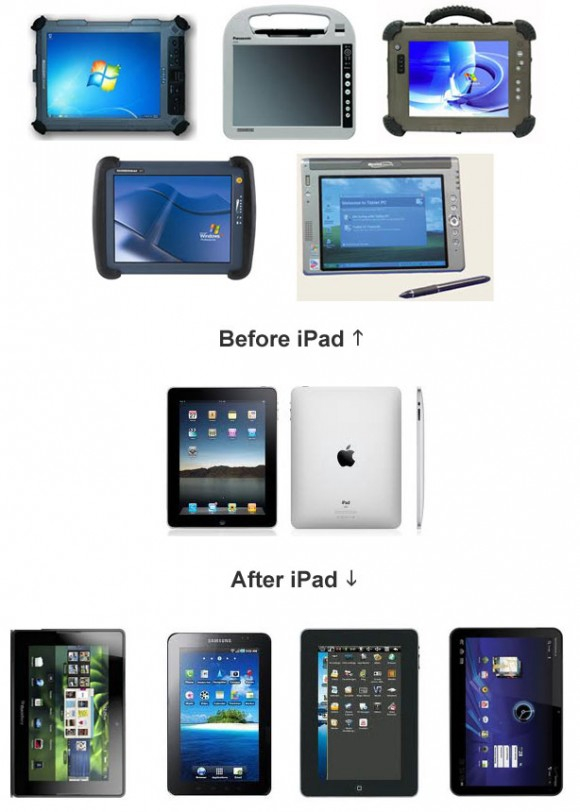
Arguably, forcing other company's to innovate could be a Good thing. Is a rectangle with rounded edges the one and only perfect tablet shape? I don't know, but if everyone just copy's the iPad it's going to take a even longer to find out.
The windows tiles may or may not be an advance, but they are clearly not a row of buttons just like the 1st gen iPhone and 2 out of every 3 smart phones that followed.
We can argue whether or not it's right for Apple to fight to protect this design, but let's not pretend that these tablets were developed completely independent of the iPad's design.
Some of those earlier tablets had rounded corners.
I imagine many of them would have looked much more like the modern tablets had technology been available at the time. For example, the battery, the weight, the durable glass, the display, the wireless options... all these things contributed to the ability to make a tablet without big rubber bumpers on the side of it.
Yes, Apple's design is nicer looking and they should be respected for pushing forward the manufacturing technology. But we don't allow auto makers to sue each other and block the sales of entire models because curves are in fashion one year and more angular shapes in fashion the next.
>The windows tiles may or may not be an advance, but they are clearly not a row of buttons just like the 1st gen iPhone and 2 out of every 3 smart phones that followed.
Well I owned three phones back in 2002-2006 which had rows to buttons and were not iPhone. I get that iPhone is a great phone but please give credit where its due. Even BB had rows of button.
I know the iPhone was not the first phone that had icon's like that, however the Black Berry and Windows phone had both buttons and a menu interface. Which IMO is better than the early iPhone style page interface when you have lot's of icons. Apple ended up improving things by adding folders, but I did notice a lot of other phones that IMO copy'd the bad design elements of the early iPhone simply because it was so popular.
Edit: Not that iPhone was the first to use those elements, just that they where copying whatever the leader did. If windows phone starts to win I expect a switch to a lot of 'tile' interfaces.




I really hope this comes back to bit Apple in the ass. It seems there has been a story about Apple doing something shitty everyday for the past few days, and the taste it leaves in my mouth is just getting worse and worse.