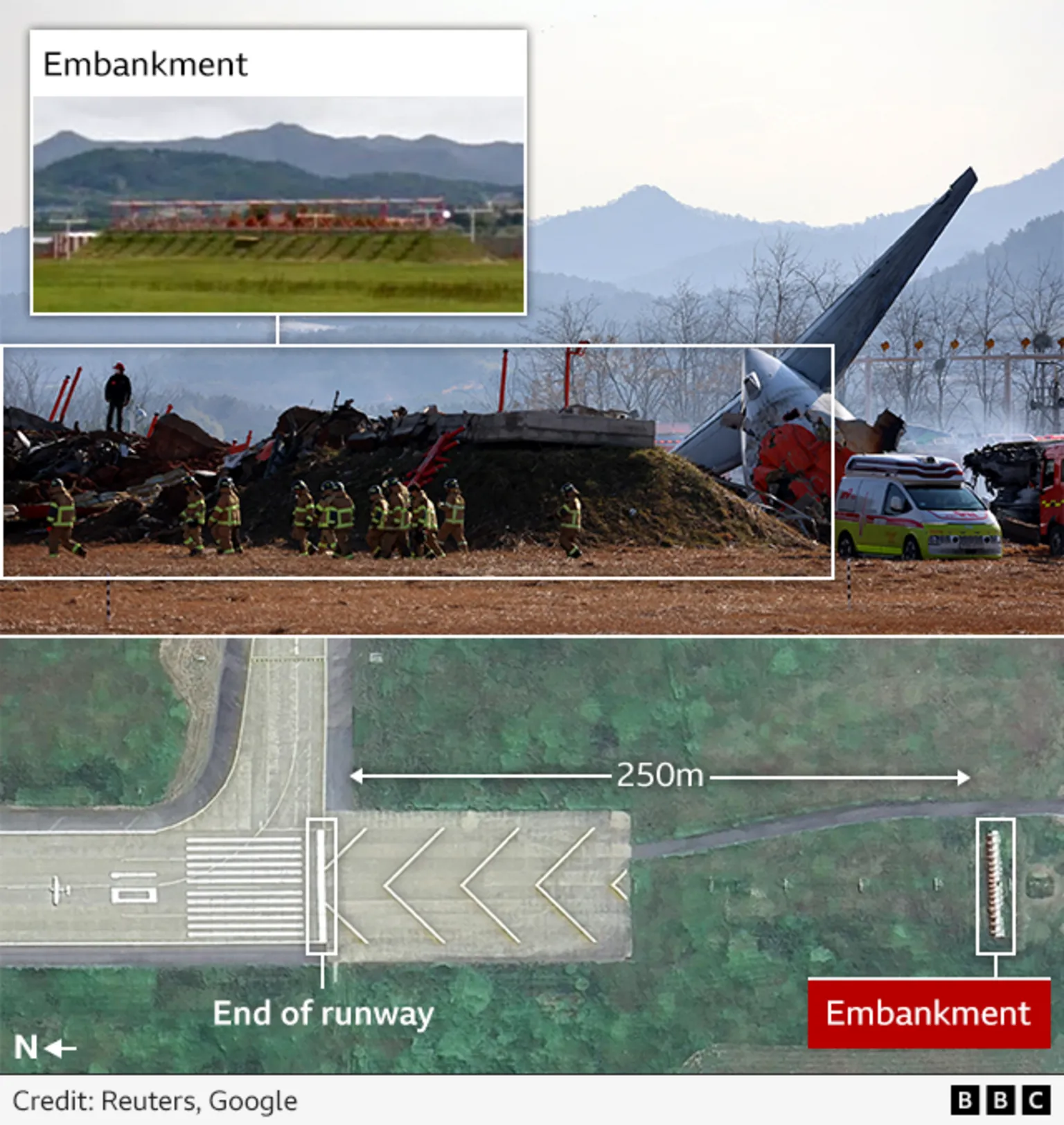
I don’t know why people keep fixating on this. Airplanes can’t skid out of the airport into the surrounding city. Mistakes were made, but this isn’t one of them. I suspect it is people trying to deflect blame from pilot error, which seems by far the most likely issue. They did none of the things you should do to stop a plane.
There is nothing beyond the embankment. Airports are generally made in the middle of nowhere. And no, they are not "skidding" into the surrounding city, he probably needed a few hundred meters at most.
He’s going extremely fast, a few hundred meters would do nothing. I think the estimates I saw were over 150 knots. That’s about 77 meters per second.
I found this comment helpful from a Reddit thread.
>The embankment is there to protect the road from the jetblast of departing aircraft in oposite runway direction. Thats why it is allowed directly in the safety area.
> a few hundred meters would do nothing. I think the estimates I saw were over 150 knots
Show you working. Not feelings because people don't have intuition for such unusual motion. You could equally have said "a few hundred meters would be enough."
Thanks for the link. Nowhere it seems to indicate that the friction of the breaking would be greater than the friction of the hull, since the pages related to non-destructive braking.
Airplanes use disc brakes. These can provide pretty much unlimited friction and are very destructive to the brake pads. They are effectively limited by the static friction of the tire and how much waste heat they can dissipate without blowing the tire.
Look it feels like you want to win an argument. You can only win it for people who do not understand the difference between static friction of a tire on tarmac and kinetic friction of a hull on tarmac. I couldn't tell you off-hand which has more friction, but I'm ready to believe by example that the hull has bad properties when it comes to braking. It's made for low friction after all.
Maybe not all completely aligned straight forward with the landing, but it looks like yes there are some inhabited zones over there surrounded by wooded parcels, well before the landscape change for some sea.
Like doing what things? What I read so far is that they suspect the pilot had control issues.
I don't think people who say that it's a bad idea to have a concrete wall at the end of the runway argue the plane should make its way to a nearby motorway. I think most refer to using EMAS, ie a crushable concrete floor in which the plane sinks and stops.
EMAS is designed to crush under the pressure of all of the aircraft's weight pushing down on the relatively narrow contact area of the tires. There were no tires in this case. I am unaware of an EMAS that has been designed or tested for the far more broadly distributed weight of a belly landing.
> bad idea to have a concrete wall at the end of the runway
but was it the end of the runway? As I understand, the pilot came in from the opposite direction, i.e.
> The pilot then aborted the original landing and requested permission to land from the opposite direction.[1]
So that wall was located at the beginning of the runway if the runway was used correctly.
From the bottom image[2], it would appear the wall is located behind the point where planes begin their take-off (and I assume their landing) - but I'm no aviation expert.
The 737 is one of the most popular aircraft in the world. It's had hundreds of incidents. There is no reason to think that there is any conspiracy going on, and there is not sufficient information to even think that any Boeing specific details were a factor in the incident.
South Korean communities are fixated on this wall issue to an abnormal degree. Discussion of this wall has become a congregation of people who
1. See this tragedy as an opportunity to deride province the airport is located in.
2. Want to be contrarian to those who tell them to wait until official results are out.
3. Feel like the society is "forcing them to mourn" (whatever that means) and would like to look at the cold hard "FACTS".
It's a mess.