I've sort of turned around in my opinion o Greece.
I started out by seeing this as the Greek Government being cynical, corrupt or incompetent and running public finances into a wall. I still think that's true. That happened and the greek government including the electorate are to blame.
But that is not the main story here. The main story here is what happens when a government does go bust. Sovereign debt doesn't come with these kinds of strings attached. If your debtor can't repay, you don't get to run the country. I think there are two bigs aspects to this whole greek story.
First, is that taking away national currency is taking away the ability to print and devalue your way out of trouble, which really increases the risk of government insolvency.
Second (this is where I've kind of turned around), I do think Germany and the EU are in the wrong. First, is the very german/west european idea that instead of a contingency plan, you need to make sure nothing goes wrong. Regulations and controls. This may work for germany, but it will not work everywhere. Other EU governments will go bust in the future. It's inevitable.
Third, banks run the world. Governments were already very cosy with banks. All the big markets and big fortunes go up and down with the slightest hint of bank health. Everyone is paranoid of banking issues causing wider collapse. Since the banking collapse, bank health has become completely equivalent to economic health. The economies are being nudged and designed to suit them. Central banks and finance ministries top priority is bank health. They are the favoured child.
Backing up a little, Greece's no strings soveriegn debt was converted into EU, Germany & IMF debt with strings in the panic phase of the crisis. Private banks were granted immunity from their bad debts to Greece and the IMF/EU is now acting like a leg-breaker loan shark demanding impossible payments or else. They are tying EU membership to repayment. That is not fair.
The EU needs a bankruptcy procedure. A way for insolvency to be resolved and a way for bad loans to absorb their due share. Greece's government did run the country into insolvency. But equally, these banks did a bad job valuing risk and making loans. Who says sovereign bonds need to be risk free anyway?
Who says sovereign bonds need to be risk free anyway?
Absolutely! Default, and we'll just charge more next time. Whatever. Move on.
The motivation for this extremely anti-default push has not been clearly enough laid out, methinks. Bonds, government or not, are an investment. You think I am 100% the stocks I bought in a Ukrainian egg farm will not go bust? Hell no. All who invested in Greek government bonds should have done their homework.
Precisely! This sort of mentality that the system has a duty to protect investors from being burned is completely upside-down in my eyes. It's the investors that must take the fall when the entity they invested in goes bust, definitely not the gov'ts at the expense of the taxpayers.
Imagine if we used the word "investments" instead of "loans" for these government bonds. One word change and everyone's perceptions would drastically change.
Well to the layman like myself, bonds and investments sound different. With a bond I expect there to be some security or asset backing it that I could potentially recoup if you default.
I don't know like say, Greece loses some it's territory in equal worth to it's debts?
This was the problem in 2010 and as far as I understood it a lot of e.g. German banks would say: We are done if they default... that's why they shifted the debt to the IMF/European countries.
> First, is that taking away national currency is taking away the ability to print and devalue your way out of trouble,
This is only true for the United States and, partially, for the UK, any other nation on this planet cannot just print their own paper-money and convince lots of foreign investors to buy local-currency-denominated debt. It pains me whenever I see this opinion posted whenever the Greek crisis is mentioned, because I grew up in a country where inflation was running in the high-double-digits for an entire decade, and trust me, there were lots of "trouble" for the Government and for us, normal citizens.
Nevertheless, I think you're spot on with the rest of your comment, I never quite understood how come the Governments are so enamored with the banking system (to this day I think that the 2008 financial crisis could have been a lot less worse had Bear Stearns been allowed to go bust with no strings attached in the early spring of 2008, and its creditors to accept the haircuts). I also believe that no-one knows where this is all going.
I think the parent is referring to the ability to sell bonds (borrow money) in their own currency. If Zimbabwe wants to borrow money, nobody will agree to be repaid in Zimbabwean currency. So, they need to borrow in foreign currency, which they can't print.
But, I think he overstated that point quite a bit. First, most countries do sell bonds in their own currency, so they can print and devalue to pay it back if necessary. They use a combination of their own bonds and foreign denominated bonds.
More importantly (especially in Greece's case), most government's obligations are not bonds. They're salaries, pensions and other things denominated in local currency. If Greece had its own currency, they would print more of it and use that money to pay government salaries and pensions.
It is true though that the US has an advantage. (A) they have very little foreign currency obligations and (B) inflation is like a cost to everyone that holds a currency. When the US prints money, the cost is spread out among anyone who holds dollars. Lots of them are not american.
>>If Greece had its own currency, they would print more of it and use that money to pay government salaries and pensions.
Doesn't this lead to hyper inflation situations. Basically money is what you trade for effort. When you freely "print money" you are simply supplying a lot of cash for the same effort. In return you simply pay a higher price for the same things.
There fore only way to increase the supply of money is to increase trade able effort in some way.
How will simply printing money solve anything? And how are few countries exempt from this rule?
It causes inflation. A lot of it causes hyperinflation. With lots of extra caveats and clauses, naturally.
You can think of it as a tax on everyone who holds the currency (or other assets directly tied to it, like bonds). If the government prints money, they have it and they can spend it on (for example) salaries. That solves the problem of not being able to pay salaries.
No country is exempt, but if a lot of foreigners hold reserves in your currency, they have to share in the cost of inflating it. Al lot or a little is relative to the total stock of money in circulation. Lots of countries hold US Dollars, so the US can print with milder domestic consequences.
Its a bit tricky but thing is that "money printing" can be used to buy domestic goods and services, that in turn help pay down business and personal debt.
This while also devaluing the currency vs foreign ones, benefiting exporters while giving the population a incentive to spend domestically.
But it has to be performed while there is otherwise a slump in the overall economy. I think term is countercyclical spending.
And it has to be used on domestically produced goods and services. Otherwise one is just asking for trouble.
I agree with a lot of what you're saying here. Greece should never have joined the Euro. There needs to be a procedure for an orderly default within the Euro. A lot of the bailout conditions were counterproductive.
But I disagree with the "strings" argument. If Greece defaults, the troika is threatening to do nothing more than stop loaning money to Greece and its banks. That's it. No leg-breaking.
The issue that Greece's banks are utterly dependent on constant and increasing loans from the ECB in order to stay in business. This has been especially clear in the last few days: the ECB stopped increasing the amount of money Greek banks are allowed to borrow, and in response, all of the country's banks are closed and the ATMs have been limited.
I think you also have the wrong impression about banks. I agree that people overreact to something like the collapse of Lehman Brothers (an investment bank). But this is something different. The Greek banks aren't just sitting on a hoard of their own money that they're afraid of losing. The money in those banks are deposits from the Greek people. When people say they are worried about the banks failing, they aren't concerned for rich people who run the banks, they're worried for the regular people whose life savings are deposited in those banks.
The only reason you have this opinion is because perhaps you have mentally disconnected from the basic idea of money. Imagine we were all still using salt to trade for goods and services. Then things might start to make sense.
If a country produces nothing (or not enough) and counts on borrowed salt to survive, failure is guaranteed. If a country gives away salt to people who do nothing in exchange for it, failure is guaranteed. If a country does not develop financial discipline, failure is guaranteed. If a country elects people to government who are only there to enrich themselves and don't do what's right, failure is guaranteed. If a country manufactures starts to use devalued sand that no other country will accept instead of salt, failure is guaranteed.
etc.
On a global market a country IS a business. In order to be successful it has to operate at a profit. Period. This understanding is what seems to be lacking in many electorates. They vote with emotion and out of selfish positions at the cost of completely ignoring that the national balance sheet is, perhaps, the single most important determinant of how well they, their children and future generations will live.
Banks have nothing to do with it. They can't force you to consume or produce salt. How responsible you are with salt is what determines the outcome. Banks just hold it and loan it.
Yes, brutally oversimplified. Yet sometimes oversimplification can sometimes help someone think and understand something. Yes, reality is far more complex than you and I walking around with little sacks of salt. And yet sometimes it isn't much more complex than just that.
> On a global market a country IS a business. In order to be successful it has to operate at a profit. Period. This understanding is what seems to be lacking in many electorates.
So if countries are businesses, and they all have to operate at a profit, and one country's revenue is another country's expenditure, where are all the deficits that balance out all the surpluses? The fact of the matter is that it is impossible, like squaring the circle is impossible, for every country in the world to be surplus country as you propose.
Also, as an aside, using a barter metaphor to describe a global, industrialized economy is overly simplistic to the point of being useless, as you pointed out. It's useless the point of being misleading and leading to no more of an understanding of a very complex system.
> where are all the deficits that balance out all the surpluses?
Where did I say that the system would balance out?
There are countries that will under-perform for a myriad of factors. That's a fact. These countries will require the charity of those doing well (with rules as to how that assistance is to be used).
It's also a dynamic system. Today I make a profit and tomorrow you do. It's a pendulum that achieves some degree of balance at the right time scale.
Also, resources and economies change over time. Compare the world 1,000 years ago to today. It's not a static playground.
Greece will not leave the EU over this, and doesn't have to. Really nobody wants this. The Greek don't want that, and no EU country wants that. This is not going to happen.
I'm a EU citizen - from a rich country, without much corruption, and I don't see how we can change the Greek society within a reasonable period. I don't know what will happen, but I hope the EU will help Greece with many billions to help local people to survive.
This is a hard lesson for the Euro countries. They shouldn't have Greece let in, as well as several other countries. That's hindsite, but as we let them in, it's our responsibility as well. If you invite a country in which has a corrupt system, where not paying taxes is allowed on a massive scale, then you invite problems.
the origin of the crisis was private debt, as in loans issued to businesses and individuals.
That debt, while boosting consumption in the short term, end up restricting consumption in the long term.
What then happens, depending on government action, is either a deflationary depression, or a increase in government debt.
The latter by having the government buy domestic products and services that would otherwise be laid fallow as the private sector instead focus on managing their debt.
This is what is happening not only in Greece, but also Ireland, Spain and Italy.
In all of those places euro-zone banks were offering cheap loans. This could be observed by way of building booms and similar.
So in effect what the ECB, IMF and others are doing are bailing out French, German and other private banks, and that is where the majority of the payments to Greece etc end up.
This while Greece etc are burdened by a domestic recession/depression as local industry etc go bankrupt from debt burdens. This in turn lead to masses of unemployed that the government is pledged to take care off via various support systems.
My impression is that Germany and the Eurogroup are obsessed with punishing Greece for exposing this weakness in the Eurozone. They explicitly say they want to make an example of Greece to discourage other countries from voting for left-wing parties like Syriza with economic ideas that don't fit into the destructive "austerity" dogma.
The Greek economy has never been very strong, but the austerity measures imposed on it by Germany and the Eurogroup are really running it into the ground. Greece has paid off part of the debt, and yet the debt has grown in relation to the GDP, because the GDP has gone down that much.
Ruining an economy is not a good way to save that economy, and certainly not a good way to get it to pay back the debt. But they're not interested in helping, they're interested in punishing. To keep the voters of other countries in line and supporting their destructive neo-liberal policies.
I like the somewhat glib cliche, "If i owe you a thousand dollars, I have a problem. If i owe you a billion dollars, you have a problem"
It captures so much of the essence of the relationship. With small debt, a person or a corporation or a government can generally work something out. Skip some unnecessary spending, scale back a bit, and things all work out.
But debt chokes off options. Too much debt, and growth stalls. It's a really vicious circle. If we upgrade the factory machines, we can sell more, but we can't afford to. If we move closer to work, we'd save some expenses, but we can't afford to. Opportunity becomes rare, and it's demoralizing.
I totally understand creditors need their money back. Presumably there was something magical about Greece, some golden egg it was producing that enticed the lenders. I don't see how they can get their money back without killing the goose though.
> I don't see how they can get their money back without killing the goose though.
And that's the problem. They seem to be willing to kill the goose, uncaring that this involves real lives of real people.
If the Eurogroup really doesn't want a deal that Greece can live with, then Greece has no option but to default. And as far as I'm concerned, they may as well default on their entire national debt. Start with a clean slate. Reform the economy, and convince investors that this time you will be able to pay all the new loans back. And try to avoid getting so deep in debt this time.
Greek banks bought about 15B of this Greek debt, which is over half of Greek GDP. This is likely the savings and pensions of a lot of Greek people. There will be bank runs (much worse than now). There would be looting, burning, and massive chaos.
It would be like destroying 8 trillion in people's savings in the US and just hoping it all works out. It would be a catastrophe.
Then, once this destroys the economy, getting any outside investment to help will be impossible, because no one would want to invest or loan to a place that so willingly shrugs off repayment.
This is why the situation is such a problem. Just unilaterally ignoring repayment destroys the Greek economy much worse than it is now.
Go the Iceland route. Didn't they create new banks for the savings of the people, and let the old ones go bankrupt? That did set a lot of bad blood with foreign savers who'd just been lured in with high interest rates, but whose savings were not guaranteed by the Icelandic government. But in the end, that turned out alright.
Exactly what I'm thinking. But when banks get in trouble, politics bail them out. They should have let them go bust, because now everyone is paying to keep them alive.
Letting banks go bust will be though at first, but it's the only thing that will let the economy work properly in the long run.
Thing is, Germany took over the debt from the banks, and Merkel promised the (understandably skeptical) German voters that she would get all the money back.
>>First, is that taking away national currency is taking away the ability to print and devalue your way out of trouble, which really increases the risk of government insolvency.
You basically summarized why the entire concept of Euro has been fundamentally flawed to begin with.
I was wondering the same thing. One of the original challenges to the shared currency question was its implicit subjugating of sovereignty to the currency oversite committee. Back during the voting I recall an editorial asking people if they would let their neighbors balance their checkbook, why would they let Brussels run their currency. And of course if you can make the government do what ever you want to its people in order to keep it solvent, is it really in charge?
Europe went for a much looser union than the union of the United States. It has never been clear to me how you could have an economic federal government but not a military nor social federal government. Greece is putting that question to the test and the outcome will have a big impact on the future of the EU.
There have been a number of great write ups on the challenges Greece faces, although two combined in a hugely negative way, one is that tax compliance (which is to say the number of people who pay their taxes as they should) is quite low, and the other is that government sinecures (jobs that don't require any work but get you paid anyway) were handed out like candy in exchange for support or other political favors leading to a lot of people (often highly paid) that were consuming government funds and producing no value.
If a government has no money, no taxes and nobody willing to loan it some money, then it can't pay its workers. And while it is easy to get someone a job that has pay but no work, it is hard to get them to work with no pay.
If someone could start a social media campaign, "Pay your taxes, its the Greek thing to do." and the people were able to get individuals out of government positions who were not adding value, the crisis would resolve nicely I expect.
I don't think your gold analogy is correct because nobody can create gold out of nothing (mining requires a ton of work). Fiat currencies however can be create from nothing by central banks and normal banks (multiplicative effect due to fractional reserve lending). What violates the Greek sovereignty is the fact that a bank they don't control can create their money out of nothing.
They overspent. Their economy is dysfunctional. They share a big part of the blame.
But they have been following the Troika's plan for over 7 years now, they have reduced spending, they have done a huge effort, and still their GDP has collapsed. It seems that the Troika's plan is not working.
That is what Tsipras is saying: we can not continue doing this, and the rest of Europe/Troika has to recognize part of the blame. Not only that: it seems it has the support of his people (we'll see on Sunday)
If Greece had defaulted (or restructured the debt) at the beginning of this crisis, as Iceland did, the situation would be much better. But nobody was interested, since big banks where holding big chunks of high-paying Greek debt, and they needed some time to unload it.
I still remember how the Iceland success story was completely ignored by European media - and still is.
Austerity plans always fail to produce results. They never work. They never worked in any of the dozens of countries the IMF and World Bank forced them on in the developing world, they didn't work in Ireland, and they aren't working in Greece.
Austerity isn't just faith in the absence of evidence, its face in spite of overwhelming evidence.
The UK GDP actually performed better during the Great Depression of the 1930s, and that was despite deflation due to the gold standard in the early years - doesn't sound like a success story to me.
I've always wondered about Ireland - it seems they have a strategy for the last decade or so of positioning their country as a tax haven, so that multi-national corporations tend to incorporate in Ireland and move their profits that are actually made in other countries there by creative accounting (like Intellectual Property licensing deals between subsidiaries). What effect does that have on GDP? Has anybody investigated this?
I wouldn't say it never works: containing spending is good policy. It worked, for example, in Spain. But Spain had going for it that the economy (although badly performing) was doing much better than Greece at the start of the crisis, and specially that the markets had somebody else to bet against, namely Greece. The Spanish bond risk premium (compared to German bonds) was widening rapidly, but the Greece one was humongous. So, the market pressure was a huge problem for Greece.
While the market was betting against Greece (and making handsome profits with big interests and, as we now know, zero risk), Spain was quietly improving.
I am sure that, if Greece had been brought to its knees by the market, the next to fall would have been Spain (well, the next in line was probably Portugal).
In that situation, austerity measures are actually counter-productive. This is what we have in Greece. Europe needs to face the markets here.
And the problem is that, once Greece defaults in the following weeks (if Europe decides to let it fall, that is), Portugal will be the next to feel the pressure. Spain is probably out of the woods by now - by luck, so to speak.
This is nonsensical slogan talk. Austerity means spending less. Every government that ever balances its finances is practices austerity. You can make an argument that Greece cannot pay back its debt, austerity or not.
But, the argument is thrown around in this crazy way that suggests the only rational choice is to keep borrowing and spending. There is some keynsian-like explanations that might support this but, at some point (greece has crossed it) no one will lend you any more money so its moot.
> On October 6, the Icelandic legislature instituted an emergency law which enabled the Financial Supervisory Authority to take control over financial institutions and made domestic deposits in the banks priority claims. In the following days, new banks were founded to take over the domestic operations of Kaupthing, Landsbanki and Glitnir. The old banks were put into receivership and liquidation, resulting in losses for their shareholders and foreign creditors. Outside Iceland, more than half a million depositors lost access to their accounts in foreign branches of Icelandic banks. This led to the 2008-2013 Icesave dispute, that ended with a ESA ruling that Iceland was not obliged to repay Dutch and British depositors minimum deposit guarantees.
So, what you're saying is default and fuck over foreign investors.
Exactly. Default and fuck over foreign investors, because that's what investors are for. They take risk. If they win, they get profit. If they lose, they carry the loss.
This entire mess is getting out of hand because Germany wants to shield the investors from that risk.
>But they have been following the Troika's plan for over 7 years now
Except they aren't. They aren't fixing their tax fraud - no one is paying enough taxes. They didn't fix their retirement age, there are easy loopholes around it, etc and a million other things.
Greek fraud predated this plan and worked during this plan. The EU cant fix Greece's corrupt governments and leaders. That's why we're where we're at right now.
Also Iceland is a edge case. It has one tenth the amount of people of the city I live in. Its like a small suburb going broke. Greece has 12 million people. More than likely you're looking at an Argentina-like situation.
> They aren't fixing their tax fraud - no one is paying enough taxes.
This is something that takes a long time. It is unrealistic to expect Greeks can fix something like this in the time-frame needed to solve this crisis. Worse, during a crisis there is pressure to escape taxation making the job a lot more difficult.
I'm from Portugal. Portugal had Greek levels of tax fraud in the 80s. It took twenty years, from the late 90s onward, to get to decent levels of fraud. I rate the work done here as excellent. And even then, it took two decades!
If Europe were serious about helping Greece, they'd be assisting with setting up an efficient finance ministry, not jacking up VAT levels and pushing more of the economy outside legality.
Ok we got it, you don't like Greeks even though you are one. No need to reiterate a thousand times. We judge the austerity program and theoretically, with your assertions on the volume of flaws in the Greek economy, it should be easy to demonstrate improvements in 6-7 years. The opposite happened, therefore something was wrong with the imported wisdom and despite the moral integrity of the troika (the troika is not Greeks, that should give you some confidence.)
I'm not sure if this is accurate or not, but didn't Argentina get fucked by the IMF? I know a lot of those South American countries were essentially hollowed out by IMF and forced to privatize a lot of their natural resources resulting in tremendous amounts of wealth inequality and a shrinking of their middle classes.
Of course, this is along with US Military backed coups happening left and right to any country which didn't privatize their countries resources so that American and Western European corporations could get "their share" (i.e. Nestle which still controls something like 90% of the bottled water market in South and Central America).
Gotta love Friedman and his Chicago boys! "If no one will elect us to power, we'll just support dictators! Free market principles at their finest!" - My made up quote for Milton Friedman, Jack Lew, and all the rest of those cronies.
Anyways, I'm at work, so I can't look up sources, but "Shock Doctrine" by Naomi Klein is a great read about this sort of thing.
2 points:
#1 Do you have a link for "Nestle owns 90% of the Central and South American bottled water market" ?
#2 How hard is it to compete in the bottled water market?
They are to blame for the mistakes committed up until the bailout. The destructive IMF/ECB mandated policies, that held down Greece's economy from any possibility of meaningful recovery all the while making the citizens poorer and poorer, all so that the big banks could effectively have the risk from their investments offloaded to the taxpayers, is totally not Greece's fault.
The question is what now. They have cut spending. They still can't pay on their loans. They can run their government, but not pay back the debt.
If you care mostly about just dues or moral hazards, there are two sides to a bad loan: borrowers and lenders. When things go bad, the borrower suffers bankruptcy and the lender suffers a default. The lenders need to get their dues too. The German government decided to bail them out (with the EU & IMF), so they won't. That part isn't Greece's fault.
Lending is not the only problem. If you drive like crazy you are the problem, but if all policemen in the city see your dysfunctional driving for many years and just smile and do nothing to stop you and finally somebody died, the police is also part of the problem.
How many surveying organisms in Europe related with economy failed to see this coming? All? What is the statistic probability of this happening just by chance in Ireland, and then in Portugal, and also in Spain, and again in Greece, and...? All at the same time...
Banks need to bite the bullet, too. Private banks were apparently smart enough to dump this on the IMF.
I don't have a problem with the IMF going bankrupt. Private lenders can better deal with these kinds of shenanigans anyway. The threat of bankruptcy forces them to spread out their risks better.
EU needs a way to press debtors into paying their debts. Like, aerial mining of ports will be a nice first steps for a country so dependent on shipping. After all, the problem is solvable, they CAN pay - by simply taking away part of their national territory and annexing it to say, Germany, with Germany then repaying other creditors.
Honestly Greece needs to default if only for their citizens to have to own up to the mess their politicians have made and continue to make. The EU has to cut them off simply because bending to Greece's demands pretty much will open Pandora's box.
Alexis Tsipras and his government have accelerated Greece's decline with their rhetoric, driving bank money out which is reducing the money supply which constrains any recovery. They had to lock down the banks because their economy cannot simply exist on money the state has banked
The EU was never meant to be a transfer union, if it headed that way all the rich nations would likely bail and current politicians would face political defeat.
Close to home (US) Puerto Rico is having difficulties paying their bonds for similar reasons, believing that they could get bailed out just because of what they are.
> Honestly Greece needs to default if only for their citizens to have to own up to the mess their politicians have made and continue to make.
That's not the whole story. The reason Greece is where it is today is because of the cruel austerity package imposed upon them by their European creditors. Here's a chart of their GDP: http://www.tradingeconomics.com/greece/gdp
Now of course there are other reasons as well - Greek manufacturing is non-existent, partly because they outsourced their manufacturing to Europe, who went to Greece en-masse for vacations, but then didn't when the global financial crisis hit.
And of course, having an integrated currency but separate government structures isn't the best idea when you have multiple economies that are at disparate levels of wealth. In an ideal world, Greece would have been able to manage their currency and exchange levels (ie. print money), but of course they couldn't.
As part of the EU, Greece essentially got the worst of both worlds - high import costs, lower (relative) income from tourism. And no control over their own currency. And to make matters worse, they got shit treatment from their creditors - their GDP has plunged since the onset of austerity measures, as has government income.
While perhaps Greece could have done more, they did what they were expected to as part of the EU, and it backfired horribly. Now they're finally doing what needs to be done, and the EU cries foul...
Regarding that GDP: it's important to note that borrowing money (and spending it) pretty much directly increases GDP. So saying that austerity is causing a decline in GDP is only half the story: Greece borrowing too much money was one reason it was high in the first place.
>That's not the whole story. The reason Greece is where it is today is because of the cruel austerity package imposed upon them by their European creditors.
History doesn't start in 2010. Greece pretty much lied to get into the EU and is a badly run country, at best, and a corrupt hell-hole at worst. Low retirement ages, low taxation due to fraud, government being the largest employer, lack of diversification, etc.
Its easy to take this hip anti-EU position for upvotes here, but you're defending a shittily run country in almost every respect.
“In the public sector, 7.91% of pensioners retire between the ages of 26 and 50, 23.64% between 51 and 55, and 43.53% between 56 and 61. In IKA, 4.44% of pensioners retire between the ages of 26 and 50, 12.83% retire between 51 and 55, and 58.61% retire between 56 and 61. Meanwhile, in the so-called healthy funds, 91.6% of people retire before the national retirement age limit,” Vroutsis said.
Government is the largest employer in most economies. 40% of the US' GDP is accounted for by the government, over 50 in Nordic countries.
All developing economies have corruption and productivity issues, the problem isn't that Greece is below the European par, but that they haven't been given enough time, and European creditors set them back a decade.
Sorry, could you explain where the 40% number came from? I see 22% (which I calculated as $3.8T US 2015 fiscal budget [1] divided by $16.77T US GDP [2])
Given your view, which I largely share, shouldn't the banks suffer as well for lending so much money to such a shittily run country? The so called bailout has been nothing more than a means of giving money to German and French banks without the German and French governments doing so in a direct manner. Germans and French get to blame lazy Greeks without having to blame their bankers.
Don't forget that Greece received financial help (IMF etc) so that creditors (big banks, really) could get their risky loans (with high interest rates) repaid, de-facto unloading the private-held debt on the European taxpayer.
This was much worse than a transfer union (where countries are supposed to help each other in times of crisis, alleviating suffering of the people): it was a direct transfer from the European taxpayer to the big banks - mainly French and German. This was neither in any way legitimated by the public, nor is a Eurozone mechanism. It was decided by the European financtial institutions because it made financial sense, so that the European financial system would not collapse.
Once this has been accomplished, it seems that Greece can be disposed of - risking even the disintegration of the Eurozone. Not much good can come of this.
So let's put this in perspective: Germany has benefited manifold of the european crisis:
- extremely low interest rates paid on debt, as opposed to what the Greeks are experiencing. Some of this is based on fundamentals, some of this is pure speculation, which has hugely benefited Germany and hugely in detriment of the Greek.
- big capital gains for the private German banks by investing in risky Greek bonds (help for the Greeks, which was good)
- no loses on the investments, thanks to international help to unload investments once the situation has started to go out of control. They have enjoyed the upside of their investment, and thanks to intervention by the European authorities, no downside.
And the Euro in general has been a big win for Germany thanks to its low exchange rate.
Now the Germans are risking all this in the name of economic Orthodoxy, but Orthodoxy exists to be broken in exceptional times, as it has been broken in the Eurozone several times during this crisis, as the US has broken it (quantitative easing), as the UK has broken it (buying bankrupt banks), as Island (out of the crisis by now) has broken it. Germany itself has broken it several times in the past - breaking the 3% deficit comes to mind.
And now we can not break it to restructure the debt of a country with a GDP lower than the 2% of the Eurozone's GDP? Give me a break!
"They have enjoyed the upside of their investment, and thanks to intervention by the European authorities, no downside."
This is what gets me. Such is the cosiness between banks and government that this happens. Banks essentially win big time by buying bonds with absurdly high interest rates (that require herculean sacrifices by the citizens of the affected countries to even attempt to repay), all the while completely bypassing the risk that made the interest rates s high in the first place!
And yet if nations are going to share a currency, they need to have a coordinated economic policy, and that ends up happening. Wealthy states in the US perpetually give money to the poorer states, but there isn't an uproar about it. Seems like the EU was doomed to fail if it didn't allow for this.
Which is what many relatively level-headed economic commentators were saying before the Euro even launched...
Not to mention the fact that the EU was also never meant to be a debt collection agency, which means that since German and French banks insisted on buying up higher-yielding Greek debt, they richly deserve to share the consequences of it being unsustainable with the Greek taxpayer.
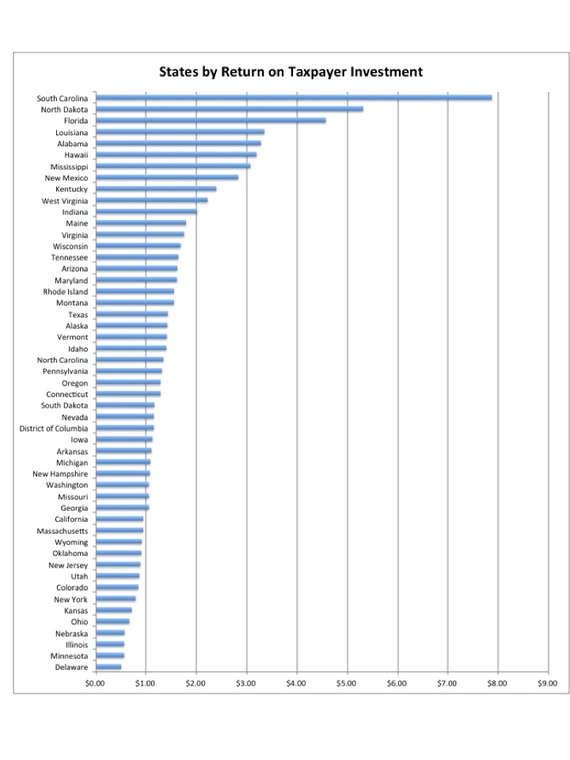
It's unclear how much wealthy US states actually do pay poorer states. Whenever I see statistics attempting to quantify this, they tend to include a lot of questionable things. For example, a military base in Kansas which defends the entire US is treated as a transfer to Kansas, and a person who worked in NJ but retires to Florida has SS/Medicare treated as a transfer to Florida.
They took Federal contracts, grants, direct payments and insurance payments to a given state and weighed it against the IRS data for the residents of that state.
Interestingly enough, of the 50 states received back less that $1 for every $1 they paid in, meaning they were net payers. The rest of the states were net receivers of federal money.
Bases that are on the BRAC to be shutdown list really should be a viewed as a subsidy. So we could quibble about what counts as a subsidy aka Corn ethanol. But, in the end you can look at any state with more federal money in vs money out and see a transfer of wealth. http://www.theatlantic.com/business/archive/2014/05/which-st...
IMO any state that's over 2:1 money in vs out is clearly being subsidized. Granted it's a rough estimate as VA probably receives more money than suggested as so many people commute into DC for federal jobs.
And things like I-80 across Wyoming are treated like a transfer to Wyoming. But if you want to drive I-80 from New York to San Francisco, you need I-80 to exist across Wyoming. It's not needed for the locals; it's needed for the cross-country traffic.
Several US states are heading toward bankruptcy. NY is very generous with its social spending, while at the same time driving businesses and individuals out via oppressive policies. PR, as noted, just declared its $72B debt is unpayable. Other states are approaching similar conditions.
Puerto Rico's debt is 70% of GDP. The worst debt-to-GDP ratio among the states is New York, at about 25%. The states have a long way to go before they look like PR.
The EU maybe not. The Eurozone, on the other hand, must have a compensation mechanism to allow for the inclusion of countries as different as the Netherlands and Portugal (to use examples far from the polarized Germany<->Greece spectrum).
Whenever a country has a chronic balance of goods surplus, its currency will gain in value. This keeps the surplus from accumulating, by making imports cheaper and exports more expensive. However, combine chronic surplus and chronic deficit in the same monetary zone, and they cancel out. Neither the surplus nor the deficit get corrected automatically by the market.
Now, you can't have a chronic surplus, not any more than you can have a chronic deficit. Either you compensate through other channels of monetary transfer (investment, differential taxation, redistribution), or you are letting the system go in freewheel mode.
> The EU was never meant to be a transfer union, if it headed that way all the rich nations would likely bail and current politicians would face political defeat.
Is that why it's so easy for the rich over there to hide all their wealth in tax havens like e.g. Luxemburg? To avoid transferring any wealth to the country where they actually made it all, via taxation?
Greece = 2% of EU GDP
Puerto Rico = 0.006% of US GDP
Both of these default decisions are more ideologically driven (setting precedents) than they are borne of actual economic necessity, such as the TBTF bank bailouts of 2008.
In Greece's case it's not even the private sector's problem anymore as debt restructuring transferred debt from the banks to the EFSF, an entity funded by public, gov't funds (mostly German, French, & Italian). [0] It's fantastic to see how these debt restructuring deals really work. In essence, creditors wrote down 25% of the debt in order to transfer private risk that they had taken on themselves onto the public.
So the direct losers in the case of a Greek default are the taxpayers and, by the transitive property, the politicians of Germany, France and Italy. Indirectly it would be a blow to investor confidence in the EU, but many would probably see Greece leaving the EU as a positive for the overall EU economy and the Euro.
This is such bullshit - Yugoslavia blew up partially because IMF external pressure (which grew stronger as a result of the country's lost strategic significance after the Wall fell) and a blowup in the current account deficit strained the existing transfer union arrangements and made proper austerity very hard to politically carry out from the center. That should have been the lesson to the EC what happens with a weak union (monetary w/o fiscal)
My pet theory is that Tsipras is pretty much a communist-lite (Greece is very far to the left politically) and is pivoting to move to state controlled most things/everything under the guise of 'socialism' and 'fighting the evil Germans/Brits/French who steal our money.' I can't see his rhetoric making any sense outside of an extremist power grab. He could be bankrolled by Russian and Chinese interests (both autocracies he looks up to - he has made several secretive visits to Moscow), sell off Greek lands to pay for bills, and pretty much become Cuba. Perhaps even exit NATO as Russia and China pressure him. The funny thing most Greeks would be on board with this.
Or maybe he's crazy like a fox and was courting Russia and China to counter the EU as gambler brinkmanship, but if that was true, there would be a deal by now, not a referendum that will, most likely, remove Greece from the EU.
As a Greek-American I'm always shocked at how extremist the people are there when I visit. They're not like Germans who take something of a middle of the road approach, at least by Euro standards. They're an entirely different beast and I think other EU members are only starting to notice. The EU taking on Greece is like the US making Cuba the 51st state. The culture and governmental divides are huge. It was a bad idea from the start.
I suspect Greece is lost to the EU and somewhat to the West for quite some time. Greeks are prideful people and "OXI" is ingrained into their culture, good or bad.
No one is deploying troops. Everyone is letting the Greeks do it. As a Greek landholder its bothersome as I'd rather not see my family's lands be given to nouveau riche Chinese for a pension check to 54 year old retirees spending all day at the caffenio, drinking frappes, and collecting pensions for the next 25+ years after barely working 30. Hopefully, it won't reach that level, but socialization of further industry (Greece's #1 employer is the government) is probably inevitable considering the politics and economic situation.
Typical entitled behaviour. Are you one of the migrant landowners that got their land as a present from the government? Maybe went to a Greek school in the states with teachers paid by the Greek government? I am in Australia and honestly I have not seen people as critical of the Greeks as Greek immigrants. I hope you settle your issues and learn to love a country that always loved its migrants. Good luck.
They're public but the agenda isn't. We don't know what deal he and Putin are striking here and how that affects the Greek people. Yet Tsipras is happy to air any EU dirty laundry, but his dealings with the man waging war on Europe and murdering Ukrainian civilians? Total obedience and a commitment to secrecy.
Putin is slaughtering European civilians wholesale and has racked up thousands of dead in Ukraine and is under EU sanctions for it. Any deal with him under the guise of 'saving Europe' is tasteless at best, and treasonous at worst. Not to mention, he doesn't have this kind of money. Greece is 300+bn euros in the hole as of today. Russia's economy is shrinking at 2-4% per quarter right now and burning through its reserve trying to keep things running.
For anyone who hasn't seen it yet, there is a crowdfunding campaign on Indiegogo to pay-off the debt. If everyone in Europe contributed, it would be around €3 each. The campaign has raised over €150,000 today:
That really puts the scale of the problem in a new perspective for me. That's $715 (at the current exchange rate) for every person on the continent just for the debt of one tiny little corner of it.
Err, Greece is in the hole for a THIRD OF A TRILLION euros. That's 1.5 years of their entire GDP. This fund is just for the immediate payment. That's on top of running in the red budget-wise sans austerity.
Oh man, would this be even possible? That is a lot of money. I'm gonna pitch in but this needs some serious traction.
Wouldn't it be amazing though? Imagine what a breakthrough it would be, this sort of worldwide collaboration, it would be very empowering to common people.
I'm not sure why I'm getting so down-voted, maybe a little bit naive, but I thought I made clear I know it's a long shot, that much is clear, but given that, what isn't true about the rest of my statement?
1) Many arguments stem from assinging moral responsibility to the Greek people. The people who will suffer most are and will be the poor in Greece, including those on fixed incomes such as pensioners. Yet these are the people with the least power over what their government does. Drive through a poor neighborhood in your town; how responsible are those people for their national government's economic policies? It's cruel and frankly evil to impose the costs on them.
2) Making people suffer is not nearly enough of a response. Nor is saying 'their suffering is not our problem'. Those are non-responses and, I think, moral failure. The people of Germany may need other Europeans' help some day -- they got it after WWII and, for example, they expect their NATO allies to defend them, with the U.S. bearing most of the burden -- they may want to set a better precedent. EDIT: "You’ll never guess which hardline euro zone country has had its debts repeatedly forgiven"[1]
3) This is a leadership failure of the entire EU. There is no way something this critical should have gotten to this point. Part of it, I think, is the failure of EU leaders to stand up for the EU's importance. The nationalistic and xenophobic right-wing, along with Ayn Randian economic policies, are ascendent and nobody is challenging them. Thus the public sees little reason to protect the EU or those suffering in Greece.
For a recent case study, look at Argentina's default and the restructuring of its debt - 12 years running now, from 2002 to 2005 and most recently 2014.
Part of the issue with Argentina - and I suspect there are similar issues with Greece - is that a significant chunk of the debt (7%) was held by US-based hedge funds that then used the US government to undermine the 2005 restructuring and force payments that Argentina couldn't afford.
Just think about the sort of financial leeches that a situation like this attracts. It really puts the whinging about commies here in perspective.
Something to note: Argentina issued those bonds under New York law because they could get better terms on debt enforced by the US judicial system than on debt enforced by Argentinian courts.
Also "used the US government" makes things sound worse than they are. What the hedge funds actually did was sue Argentina in the jurisdiction in which the bonds were issued, and win. (Though the ruling is widely criticized.)
So they issued under New York law to get lower interest rates (because creditors/bond buyers felt that the law gave them more security, because it made it harder for Argentina to skate on the debt).
Then Argentina defaulted. Hey, it happens. You didn't get any guarantee by buying a bond issued under New York law, you just got a better legal treatment if Argentina happened to default. But Argentina said, "We can't abide by the rules imposed on us by New York law; that's too expensive. Here's how much we can actually pay. Take it or leave it."
Most of the creditors took it. But some speculators thought that they could use New York law as a club to force Argentina to give them more money. So they bought up a bunch of Argentina's debt (at a price that was set by everybody else's expectation, which was set by what Argentina said it could actually pay, which means it was a really low price.) Then they sued Argentina, under New York law, to try to force them to pay the speculators more than they paid everyone else.
The speculators won in court. Argentina refused to pay them, but paid everyone else. The courts in the US refused to let Argentina's agent in the US pay the other bondholders, because Argentina wasn't paying the speculators what the court judgment said that they had to pay them.
I can't find much to cheer for on either side of this. Argentina made a mess of their finances by bad government, and is being stubborn. The speculators are greedy vultures.
But I note that it's really hard to force a sovereign government to pay you if they really don't want to...
Yes, it's definitely more complicated than my simplistic presentation. But the point stands, I think... nation-level financial crisis draws a certain kind of vulture capitalist who will exploit the crisis and then enforce misery at gunpoint through the long arms of compliant governments.
Not really. Russia defaulted in 1998 and had no trouble raising more debt. After they defaulted they suddenly had some free cash flow with which to be able to pay their new debts, and so they looked like a much better risk.
At the government level people are mostly just looking for ability to service. When you're spending 50% of tax revenue on existing debt payments, you don't look like a good risk. When you're spending 0% of tax revenue on existing debt payments, you look like an excellent risk.
It's super wacky, but that's seemingly how it works.
They can kick them out of the EU/Eurozone and implement tariffs that will pay off these debts. It'll take decades but its doable if the Greek economy doesn't completely collapse.
And there's the rub... the best way to get the debt repaid is to help the Greek economy recover, but prioritizing debt repayment over economic recovery drives the economy even farther downhill. And turning Greece into an economic pariah state with tariffs and other punitive measures is definitely a step in that direction. How are they supposed to recover if they can't engage in free trade?
They could pull a Cuba and create a completely introverted economy - poor, but independent. But if they're doing that, why the hell should they kowtow to the EU or anyone else?
No, they cannot. I have no idea where this lie started, but repeating it won't make it true: There is NO mechanism to kick Greece out of the EU/Eurozone and when the other governments try to do it the european courts will stop them.
The EU Treaty has rules regarding government debt. Greece violated the treaty by running a bigger deficit than permitted. Additionally, the Treaty does not allow for default on debt. The EU courts will require repayment. Your suggestion that the EU courts will stop a breakup with a country which is in complete violation of EU law is optimistic.
The treaty says nothing about default, and say absolutely nothing about the possibility of expulsion if a member goes over the deficit limit (or under any other circumstance by that matter), which by the way already happened to many countries including France without any major consequence.
Next time, you might want to actually read the treaty before commenting on it.
The consequences of breaking these rules are clearly defined, being forced to leave the union is not one of them. The european courts can force Greece to pay a fine if they decide that this is warranted. That is all. You cannot simply redefine the fines of a law after the law has been broken.
Invasions are illegal per EU law, or international law, or what? Because I think there have been some big wars in the last 100 years.
Remember that you're talking about institutions that have the MONOPOLY ON VIOLENCE in their respective lands. Those are the kinds of institutions that tend not to take "no" for an answer; they're used to being the final word on something.
That's what a war is, two institutions that have respective monopolies on violence figuring out through violence which one is going to be in charge.
Which the US has been doing for many decades now. WWI, WWII, Korea, Vietnam, Iraq War 1, Iraq War 2, Afghanistan, Somalia, etc.
I'm not saying that it's MORALLY right in any or all cases. But I am saying that talking about something which is illegal -- in the context of international relations -- is really silly. Governments answer only to power, and maybe not even to that.
In order to talk about something being illegal you really need to have an institution with authority over both sides of the dispute. The UN is SUPPOSED to have that, but the UN doesn't have its own standing army so it can't really impose its will on the various countries that make it up.
So while it might be TECHNICALLY illegal to start a war, in practice it's not. Especially if you're the victor.
Parent commenter asked "What recourse do the creditors have". If you aren't constraining yourself withing legal frameworks, then the answer can be "whatever you want". But I doubt that's what they meant. Unless they were asking for permission to invade Greece?
But I wanted to head off the implication that somehow debtors deserve this kind of treatment. Being in debt is not a violent act against the creditors. It's not a crime. So people should stop themselves from thinking that almost anything is justified in recovering debts. That thinking is what led to debtor jails, the practice of which was outlawed for a reason.
Right, but the idea that there is a useful, workable legal framework that's used to resolve disputes between countries is laughable. I know the UN exists and I know that's what it's SUPPOSED to be. But given the lack of any entity to enforce the UN's resolutions or findings or declarations, it's a toothless entity. And that means whatever judgements the UN makes aren't really binding. And that makes them EFFECTIVELY useless. I'm not saying the people there are useless, or that what they're doing isn't noble. Just that without the guns to make people accept it, countries can and do, do whatever they want.
There isn't much law between nations, really. There are conventions and agreements that countries generally tend to adhere to, but only out of mutual benefit, like policies regarding ambassadors or consulates or the conduct of soldiers in war. And those routinely get violated if people think they can get away with it and usually they can.
You're side-stepping my main point: when a country defaults, you don't "get" to screw over its inhabitants just because you want to squeeze a little more money out. You can try, but it's not "right".
Re: UN, the UN is not a government, it's a negotiating table. It has value to local politicians when something is agreed to at the negotiating table. It has value as a table everyone is always at, disagreement or no.
> You're side-stepping my main point: when a country defaults, you don't "get" to screw over its inhabitants just because you want to squeeze a little more money out. You can try, but it's not "right".
I don't believe I did side-step it, so let me try a little harder.
When it comes to the affairs between two countries, there are probably a bunch of things that are morally right and wrong. And there are other things which the countries agree to do or not do by treaty, convention, and the like.
But just because a thing is immoral or against convention or what have you, that in no way precludes a country from doing it. Similarly, just because a country is supposed to do a thing as per a convention or because of entirely upright moral reasons, again, nothing forces them to.
So while I agree with you that nothing really gives a country the "right" to do anything, that has little to no bearing on what countries ACTUALLY DO.
Which is why I continue to insist that what SHOULD happen and what WILL happen may have no bearing on one another at all.
Further, in order to have a "legal framework" in the affairs between two countries, you have to have a superseding authority. Which doesn't exist. So the idea that any kind of legal framework does exist which governs their affairs is a fiction. There are some institutions which have the appearance of a superseding authority like the EU or the UN. But the EU has never really been tested by violence so we have no idea if the other member countries will enforce EU decisions with force. And the UN has already proven itself toothless many times over.
So again, I'm not saying that it would be RIGHT for Greece's creditors to invade to force repayment, I am saying that it MIGHT happen. And that it MIGHT be illegal, or it might not. It depends on who wins since the victors write the history.
Right, because they're not a real government. If you can't MAKE people do something they don't want to, you're not the final word. And if you're not the final word, you're not the government. This is why the UN is a nice idea in theory, but utterly useless in practice.
Isn't the correct term entering into arrears instead of default? Doesn't the Greek government have a couple of weeks to regularise their debts before going into default?
There was a spike in Bitcoin prices when Cyprus, another EU member state, imposed capital controls during a potential default and driving Bitcoin prices up 400%. Greece is following almost the exact same path, limiting bank withdrawals to €60 per day.
It's very hard -- there's only one Bitcoin ATM in all of Greece and six businesses to spend it at -- but Bitcoin exchanges are reporting huge spikes in Greek usage:
All this spending was basically German and French money recycling through Greece, where previous German loans were paid with new ones. Default like Argentina and Iceland did, and start of a fresh slate, keeping this bloodsucking parasite called Brussels on the body of Greece is a travesty - 5 years of ruined lives already.
See https://news.ycombinator.com/item?id=9795718#up_9796231 : "we don't ban paywalled sites [because] (a) there are standard workarounds for most paywalls, and (b) banning the WSJ, NYT, New Yorker, Economist, etc. would diminish the quality of HN."
Usually there are other sources for these stories on non-paywalled site. I'm curious as to whether the HN users who upvote these stories actually pay WSJ for access.
"...actually pay WSJ for access" - or use the Google search technique to get access, which I just verified works for me. (That is, copy&paste the headline into a Google search and follow the first link to the unrestricted article.)
I'm well aware you can use google to get around it. However I think it's hypocritical for people here to upvote WSJ instead of ad-supported news sites, then post comments saying things like "would you prefer to have adverts?" and "how are journalists supposed to make a living?" if they are actually using google to avoid paying for those services themselves.
Yep, it takes two seconds to get around these paywalls and should be an easy task for anyone who is good with computers, which ought to cover the entire demographic of this site.
Of course I'm aware of that, it's the reasons behind why people are posting WSJ links rather than the likes of techcrunch that I'm curious about (see my comment above).
It is my pleasure to confirm that not upsetting the Wall Street Journal appears nowhere on HN's list of priorities.
Complaints about paywalled submissions have become so repetitive lately that I think we're going to add this issue to the FAQ and declare it off-topic in the threads.
It's fine to suggest an equally good article that isn't paywalled; if it really is equally good, we'll happily swap the URL. It's also fine to ask or share with other users how to read an article. But it's not fine for dozens of threads to bog down with the same generic complaints when this issue has been decided.
They remove paywall when visitor comes from google search results, so if you want to read something - just put URL into google search and you get to read it for free.
Otherwise they either won't get indexed at all or breach google policy that google bot should see same content as the user coming from search results.
Results to paywalled sites served through Google News tend to be un-paywalled even on articles that are usually locked down. I can't say for certain this is the case for all, but it certainly is for the FT.



I started out by seeing this as the Greek Government being cynical, corrupt or incompetent and running public finances into a wall. I still think that's true. That happened and the greek government including the electorate are to blame.
But that is not the main story here. The main story here is what happens when a government does go bust. Sovereign debt doesn't come with these kinds of strings attached. If your debtor can't repay, you don't get to run the country. I think there are two bigs aspects to this whole greek story.
First, is that taking away national currency is taking away the ability to print and devalue your way out of trouble, which really increases the risk of government insolvency.
Second (this is where I've kind of turned around), I do think Germany and the EU are in the wrong. First, is the very german/west european idea that instead of a contingency plan, you need to make sure nothing goes wrong. Regulations and controls. This may work for germany, but it will not work everywhere. Other EU governments will go bust in the future. It's inevitable.
Third, banks run the world. Governments were already very cosy with banks. All the big markets and big fortunes go up and down with the slightest hint of bank health. Everyone is paranoid of banking issues causing wider collapse. Since the banking collapse, bank health has become completely equivalent to economic health. The economies are being nudged and designed to suit them. Central banks and finance ministries top priority is bank health. They are the favoured child.
Backing up a little, Greece's no strings soveriegn debt was converted into EU, Germany & IMF debt with strings in the panic phase of the crisis. Private banks were granted immunity from their bad debts to Greece and the IMF/EU is now acting like a leg-breaker loan shark demanding impossible payments or else. They are tying EU membership to repayment. That is not fair.
The EU needs a bankruptcy procedure. A way for insolvency to be resolved and a way for bad loans to absorb their due share. Greece's government did run the country into insolvency. But equally, these banks did a bad job valuing risk and making loans. Who says sovereign bonds need to be risk free anyway?