Last year I got a chance to ride in an autonomous vehicle by a Waymo competitor in San Francisco, in and around Market Street.
It handled every situation as well as or better than a human would, including trash bags in the road, a truck driving the wrong way down a one way street, and numerous unpredictable pedestrians.
It was that day that I was convinced that we would have driverless tech by 2020, and the only thing that would stop it would be laws and regulations.
Waymo is approved for full driverless in California. They ordered 20,000 Jaguar IPaces with delivery starting in 2020. One thing they don’t have is approval to charge for the taxi service.
I think the other thing that can hold it back is time & cost. How quickly can they produce the vehicles? What's the unit cost? What's then the total cost to build a fleet big enough for the parts of the world that are ready for this?
Even Alphabet may not want to front up the entirety of the capital that would be required to scale up Waymo around the world.
They also currently only have two passenger vehicle models that can be outfitted, so they are currently also limited by how quickly those manufacturers can produce those vehicles for them. How quickly can they add a model? Probably takes at least 6 months.
I think we are still a ways from scaling. There is still a real risk of catastrophic failure as they get more real world experience. I think it is going to be quite measured, continuing to slowly roll out to actual people over next 5-10 years.
Waymo is potentially the world most valuable company some time in the not too distant future (before the commercial space industry really takes off). I doubt they will hesitate to scale once the time comes.
But my point is that it's not entirely up to them. They're currently at the mercy of just two vehicle manufacturers who have other customers as well, and may not have completely aligned interests with Waymo.
How hard is it to refactor the rigs for different models? Not much compared to getting the self driving software and data right.
If I were the car manufacturer, I wouldn't mess with Waymo, I'd do everything I could to have them locked in to me and me alone. That would not be achieved by doing anything other than bending over backwards to get this tech working and deployed
So, it's now November of 2019, and it seems unlikely that driverless cars will be ubiquitous or even an available option by 2020. If you could go back and change some laws and regulations, which ones would you have fixed to hit the 2020 prediction?
This article make it sounds like I was right. The author just took a ride in a driverless car. Which is limited to driving in Arizona due to legal restrictions.
But to answer your question, we’d need a whole different legal framework about liability for driverless cars instead of technological restrictions.
Like for example, the law ~says~ would say “one person must be designated as legally liable for the vehicle” and that’s it. Drive your driverless car on any road you want. If it hits someone, the designated person is liable.
The designer of the software should be liable for bugs that cause life and property damages. This makes sense morally, and the costs incurred from damages should be factored into the costs of pricing a driverless car.
This protects the consumer from being responsible for damages they have no control over, provides meaningful competitive incentives for driverless car manufacturers to improve safety, and doesn’t hamstring the industry’s development.
Why would anyone buy a car where they can be held liable for the software defects of the manufacturer? The driver has no control over the software and cannot compensate for it. You're blaming them for putting the thing on the road at all, and the end result would be not to bother.
While I personally wouldn’t that doesn’t stop a bunch of people from kicking their feet up and texting as their Model S’s drive them down 280 every morning. They’re already agreeing to the trade off between convenience and liability. I think you underestimate how much some people value the convenience.
That some idiots may misuse their vehicle assistive driving system is different from you having to sign an agreement when you purchase your self-driving car in which you agree to hold the manufacturer harmless and accept full responsibility for [long list of things] that may happen during autonomous operation.
I think there's a difference between agreeing to hold the manufacturer harmless for anything that happens and accepting basic liability for purchasing the car and putting it on the road.
I guess jedberg's idea is that there needs to be a place for the buck to start, as it were, wherever it might end up. Currently that is the driver. However, I don't see why it couldn't start with the manufacturer. They could always try to shift blame to the owner if they were misusing it somehow or interfering with its correct operation.
Why would anyone buy a dog where they can be held liable for the genetic disposition of its parents?
The dog has a degree of autonomy or self-agency, and can make decisions that put its owner at legal risk. Someone else brought it into the world, but you, ultimately, made the purchase.
Actually the article states that the driverless rides are limited to a subset of the total Waymo test area in Phoenix, which has nothing to do with legal restrictions but with how confident Waymo is in their technology. And, yes, some (maybe a big) part of Waymo being in Phoenix is the regulatory environment, but I bet a lot is also that there is no snow and other challenging weather conditions.
Why? Car manufacturers are usually indemnified when someone uses their car improperly. It’s not so black and white. That’s why we need laws to spell it out.
>seems unlikely that driverless cars will be ubiquitous or even an available option by 2020
this is moving the goalposts. the parent never said it would be ubiquitous, he said "we would have the tech". Waymo is currently offering driverless rides to the public, therefore we have the tech. no, it's not ubiquitous, and there's a lot of caveats, but it exists. driverless cars are a thing.
I think what you're saying is true as far as it goes. Also, if you allow cars that can only drive in a limited list of places, we've had driverless cars for 30 years. So do with that what you will.
For me, I would say that when anyone can order a self-driving car to go from any point on a road in California to any other point on a road, we're clearly there. One city seems far too small.
I used to think my daughter may never drive, because autonomous vehicles were rumored to always be just around the corner.
Now I think she may never ride in an autonomous vehicle. Do autonomous vehicles drive in the rain? We live in a northern state where snow remains on the ground for months at a time in ever shifting depths and banks along roads. Lidar is unable to see through the snow. Road surfaces are sometimes wet, sometimes snow covered, sometimes ice. Visibility can drop to zero.
I wonder if tech companies will spend the time and expense to solve these difficult problems for a rather small percentage of the population.
Baby steps. Once the majority of human drivers get off the road we will almost certainly see an evolution in traffic control systems which will allow self driving vehicles to conquer poor weather conditions. As of now, each vehicle can only rely on its own sensor package to understand the world.
Tesla already has a system in place that lets one car learn from thousands of others; ie if everyone disconnects autopilot at a certain turn each car will learn to slow down even if they have never encountered that turn before. The future will have more of this.
Self driving has mostly been a solved problem, it just only works in ports, warehouses, docks, and factory floors. You might say those are tightly regulated spaces, but so are roads! All it takes is political will to scale up the same systems that guide robots today and install them onto every highway and main road.
> Baby steps. Once the majority of human drivers get off the road we will almost certainly see an evolution in traffic control systems which will allow self driving vehicles to conquer poor weather conditions
That puts the cart before the horse. The cars need to be able to handle weather before “the majority of human drivers get off the road.” In most of the US, not being able to drive in bad weather will make self driving cars a complete non-starter.
> In most of the US, not being able to drive in bad weather will make self driving cars a complete non-starter.
This strikes me as complete hyperbole. "Most of the US" population wise is in cities, which have weather management (snow plows, bright lights), and plenty of people will buy a car that "self-drives" 80% of the time-most people's driving miles are boring highway commutes, not off-roading.
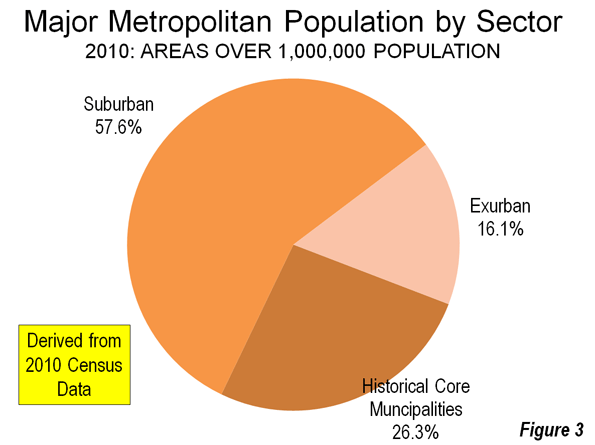
Most of the US population lives in the suburbs, not cities: http://www.newgeography.com/files/cox-uza-3.png. It can take days for local suburban roads to be cleared after a snow storm. Rain is also a significant impediment to self driving.
“Most people” (the criterion specified by OP, above) will not buy a car they cannot drive during a snow storm or rain storm. Peoples’ driving might mostly be boring highway miles, but for example here in the southeast you still need to get to work during the regular summer downpours where you can’t see the lines on the road.
I have every confidence that once self-driving cars have done a pretty good job of mastering city/fair-weather driving conditions, that ML will be able to handle poor weather just as good or better than humans. For example, humans are susceptible to panic when they start to lose control of the vehicle and do unproductive things like lock up the brakes. Even experienced drivers do this. Self-driving autos won't.
But yes, in the short term, self-driving is a non-starter for many regions during winter months or inclement weather.
I have to imagine that the duty of clearing roads of snow and such will be an early problem set for autonomous vehicles to tackle at much slower speeds when we're sleeping.
Chicago does what it can during the winter months, and is doubtless pretty competent at what it does, but the streets are still often treacherous, and the city's ability to mitigate weather effects varies between arterial roads and smaller roads. A self-driving car in Chicago would need to be able to deal with inclement weather in all the ways you'd intuitively expect it to have to do so out in the countryside.
Disagree we have huge thunderstorms and no snow. I’m not sure bright lights will help anyone. If it can only drive in clear conditions and on the the highway that’s not autonomous that’s a car with driver assist features.
But they won't only drive in clear conditions on highways. That's the easiest case to handle, but it doesn't mean they won't go further. It's obvious to go further.
Splitting hairs a bit: the qualifications and regulations for driving in ports, warehouses, docks, and factory floors are far more stringent than public roadways, and the conditions on roads are far less predictable and controllable.
> Once the majority of human drivers get off the road
This leads to a dystopian future. When the majority have given away their driving freedoms to machines controlled by corporations, the outcomes are not good.
>> All it takes is political will to scale up the same systems that guide robots today and install them onto every highway and main road
> Well, that and a massive amount of infrastructure spend.
And before we put anything close to that kind of money toward autonomous cars, I demand the spending go toward urban micromobility infrastructure first.
> if everyone disconnects autopilot at a certain turn each car will learn to slow down even if they have never encountered that turn before.
That can't be the bar. Full self-driving technology must be able to handle any situation as well as the bottom ~1% of human drivers the first time any vehicle on the road encounters it.
Check tesla auto driver mode in rain. They handle it very well so I am sure waymo will as well. These are classic problems and you can trust those curious engineers to at least think about these issues before they even started coming up with the driverless car program. Vision technology has improved 10 fold in last decade.
I own an MS and it has no idea what snow is. Once the road markings disappear, you're done.
If there's a car track, then it'll think that the cut-out created by warm cars or a plough form the edges of the road.
But if there's just snow, it has no idea. It'll easily mistake parts of the roads where snow has been crossed by tires as being dashed road markings as well.
The highway by me - well, you can stick autopilot on if you want. You'd better watch closely though, because unexpected snow patterns on the road surface will have you close to a median barrier quite quickly.
Generally if the road is fully snow covered AP is disabled. If the sensors are covered, which they will be if you've left your car outside in -10c or so, then basically everything is disabled.
Multiple Sclerosis. Also, Model S, if you frequent online discussion boards that also like to abbreviate "Model 3" to collide with a very well-known BMW.
Because people can learn on the fly, and these systems can’t.
Sure, you can aggregate the data from a fleet of cars and use that to train a better model (or set of models for vision, driving, etc.) that updates the old one, but that process takes time and isn’t as immediate as a human reaction. Not saying it can’t ever happen, but rather that it’ll take a lot of time and effort before a self driving car can handle extreme weather, rather than the calm conditions of California (which, to be fair, took an awful lot of work to get functional there, too).
Humans are good at filtering out bad information because the whole system is understood. I can’t see some of the road, because it’s snowing, and I can quickly stop paying attention to the non useful parts of my vision.
It’s definitely a hard problem, but I don’t think it’s insurmountable
Honestly, tech companies should spend their time building cars for the city. That's where most of the people are and that's where the congestion reduction will benefit the most number of people. Rural areas should be the last to update
That seems backwards. Dense cities are where mass transit is a viable alternative to cars. It would make more sense to focus on that in cities and focus on self-driving cars where individual cars are unfortunately a requirement, like the suburbs.
(Ideally we would Upzone All The Things and the vast majority of Americans would live in places dense enough for cars to be unnecessary, but making NIMBYs stop NIMBYing is harder than just making better tech.)
Car culture is so engrained in the US suburbs that people will insist that they need to keep driving themselves. You see it if you ever bring up bicycling or god-forbid walking.
Cities are the only place where alternative transportation is somewhat normalized in the United States.
You can never get rid of wagons in the city; the goal must be to reduce their use, and for that I think you must convince people that they don't need to own one, because if they do, they're more likely to use it, since the fixed costs are large compared to the marginal (per ride). And to convince them of that, you'll have to make them trust they'll have an available, affordable and comfortable alternative for those situations were they really need one.
Seems the opposite to me. Congestion and pedestrians present the greatest challenges for driverless cars. Also, they will only increase congestion both by increasing the number of cars on the streets and by being overly cautious.
Can people see very well through the snow? If visibility drops to zero (in human terms), then don’t people just stop driving anyways? Is “use the force” really a thing on the road?
During a heavy snow the accident rate shoots up anyways. If waymo does a taxi service, it would make sense for them to stop service even if the car could drive just as well as a human, it just isn’t worth the risk.
I believe the plan at the start is that bad weather will cause the vehicle to pull over and require a human driver. But that’s not really a big problem in large areas of California and Arizona where they’re starting off. And all the companies are researching bad weather driving and that feature will roll out later. Self driving cars will basically migrate north as the technology allows.
But they’re already testing in snow and rain and working on that too. I don’t think they’d really deploy to northerly areas until the tech works as well as all the rest. With enough testing experience and engineering time, they ought to be able to solve it.
What's your actual point, though? Is it that they won't try to solve the case where there's some snow on the road, or is it that this case is somehow not possible?
My actual point is that Yandex hasn't yet shown an attempt to solve that case (unless there are other videos), and therefore we can't gauge if they are even ready to attempt it.
Man I wish I could upvote this 1000 times. This is amazing. How many fucking edge cases there are in driving, and to be able to develop a reliable algorithm that can handle all sorts of situations it has never seen before.
I’m also glad to see their rollout seems to be very measured. The standard is safety is so much higher.
This article touches a bit on what I think is one of the more interesting problems - exactly where to pick up and drop off. I gotta wonder what they're doing for that. I guess most suburban homes and apartments aren't too hard, but I wonder how they handle stuff like malls, stadiums, airports, festivals, etc.
I don’t think anyone debates that LIDAR plus cameras is “better” than cameras alone. The real question is whether it is possible without LIDAR. (AFAIK all self driving cars use cameras even when they also have LIDAR).
I really can't understand how any logical person would think lidar is better here. You are driving with the sight of your eyes correct? then the AI would do the same but better.
If using driverless cars for rideshare companies becomes more popular will they start designing cars for computer control only? Has that already been started?
It seems like they would have no use for human steering controls and they seats could be moved around to open up more space for passengers.
They shouldn't. What happens if the car runs our of gas or the software/internet is down and it needs to be manually steered even a slight distance? Say up onto the lift in a mechanic's garage? There are at least few situations where direct control is easier and safer than software control.
Being designed to be movable short distances manually is wildly different from being designed to always be driven manually.
> There are at least few situations where direct control is easier and safer than software control.
Is there any direct control now? Acceleration, breaking and steering all have tech interaction.
If you don't need completely direct control and just need manual control, being able to connect an Xbox controller to a car and drive it at max 3mph would probably deal with most issues (like the garage example).
This software doesn't need Internet. I agree there must be some way to control them manually, but it'll probably be something like a gamepad than a full steering wheel and pedals.
Generally speaking, getting an AI to learn anything that a human can learn is easy, the hard parts are the competencies we acquired through evolution [0]. As such, once self-driving cars fully reach the level of the average 17-year old new driver, it should be a relatively easy path to the level of the best drivers in the world.
A geofenced robo taxi service does nothing to improve my life. The real usefulness of self driving cars will come when you can fall asleep in the back as it drives across the country. Also you can’t set up a mobile office in the back of a taxi, so productivity in robo taxis will be no better than regular taxis.
For self driving to be truly useful to the end consumer car ownership needs to be an option.
That may apply to you, but I only drive long distance once every few months. My life would be much improved by a driverless car/service which could go back and forth between my house and the train station. It's a distance of about 4 miles with three roads and two junctions. (We use driven taxis for this at the moment but they're expensive and limited by availability of drivers. Buses would also be good but it appears there isn't sufficient demand to run a regular service at a profit).
Yeah, my life is a different situation and I would very much benefit from a geofenced rob-taxi service to supplement public transport and medium range trips. I don't own a car and don't plan to, bicycle and public transport is sufficient for where I life. I don't even have a driving licences, I plan to do it one day but it's not important currently. I would never take the autonomous car to drive across the countries, i think taking the train is just the superior experience. In a car you're crammed in this tiny space, whereas a train is a smooth ride with lots of space, internet and something to charge your laptop. I don't think setting up a mobile office in a vehicle is that important for most people.
A car can go pretty much anywhere, public transportation not so much. If you can sleep in a self driving car then logistically much more of the world will be accessible to you. Hit a button, go to sleep, wake up wherever you want. To me this would be much more exciting than cheaper taxies.
Except sleeping in a car (or a bus, train, airplane) is really really uncomfortable. But cars more than the rest, since you are much more restrained due to seat belts.
That’s because cars are not designed to be slept in. Inflatable mattress and a seatbelt/harness designed to be worn lying down and the problem is solved.
Exactly. And perhaps it's even that once autonomous cars have proven themselves enough, you wouldn't even need a seatbelt for a regular ride. The car might just beep once every few hours to ask you to buckle up on particularly dangerous sections, like on an airplane.
Your use case is very limited. Using cabs instead of driving to work at a similar price point would cover majority of the population. Most costly part of a cab is the driver's time. I can browse my phone during my commute which i can't even do with my Tesla and Autopilot.
Most estimates put cost of the driver in a cab at about 50%. So if the cost of the car doesn’nge you half the cost of a cab. So maybe $1 per mile? 2x the IRS deduction for driving seems a reasonable ballpark for a managed service.




It handled every situation as well as or better than a human would, including trash bags in the road, a truck driving the wrong way down a one way street, and numerous unpredictable pedestrians.
It was that day that I was convinced that we would have driverless tech by 2020, and the only thing that would stop it would be laws and regulations.