I think this is more or less assumed to be the case already. It would be foolish to initiate your nuclear retaliation without first burning all your zero-days on widespread infrastructure failure.
For more localized conflicts this is also already routine, lots of countries in civil war order ISPs under their jurisdiction to start blocking websites or the entire Internet whenever blocking it benefits the incumbents (which is always).
In any case there are counter-measures and counter-counter-measures for such situations. It's why Starlink has always been presumed to be a financial success even if civilians don't get behind it; every government in the world (and especially the DoD) would want a satellite network that can provide Internet connectivity to any part of the world, and you would have to literally shoot down dozens of satellites to impact its availability.
> you would have to literally shoot down dozens of satellites to impact its availability.
I'm not a satellite engineer, but I'd be surprised if this is true. What's preventing jamming a small, distant satellite signal with a big strong local transmitter?
It's trivially easy to jam GPS [0] and GPS is a much less complex signal than internet traffic.
Any jamming attempts would have to be localized within a certain radius. Jamming an entire country's worth of area is probably untenable unless you are a really small country. Even then you could e.g. route communications across the border with a meshnet and then shoot them up to Starlink in a location that isn't being jammed.
This is the castle and invader problem; the castle builders must guarantee that there is no hole anywhere in the castle, and the invaders only have to find or make one hole to render the castle useless. Whereas you could cut an underwater cable and guarantee outages for at least a few days or weeks, an adversary only needs to move to an un-jammed area in order to resume communication with the greater world.
> What's preventing jamming a small, distant satellite signal with a big strong local transmitter?
Anti-radiation missiles which home on the strong local transmitter.
I'm not saying this flippantly. Obviously not all Starlink consumers have access to such a thing. The scenario I'm talking about here is when a country is trying to choke the military communications of an other one.
The big benefit of these LEO satellite constellations is that they have hundreds of satellites in them which makes anti-sat weaponry not cost effective. (Or at least that's the hope.)
The 2007 attacks on Estonia [1] and the cyberattacks before the actual attacks on South Ossetia [2] are generally believed to be a Russian test of its capabilities.
I don't exactly remember when it was, I guess around 2005 or before. In a timespan from about 6 months multiple undersee cables had been 'hit by a ship' (pre Snowden, everybody believed the story). One cable was pretty bad, so traffic to asia was almost complet broken for a few days.
I can imagine major power or North Korea doing those sort of things when the circumstances come, but the 'rich people' part is pure non-sense.
First of all they have no interest in doing such.
Secondly, Attacking cable infrastructure using submarines is in effect a declaration of war (or act of terrorism). I understand this world gives you this illusion that money = power, but just remember who prints the currency, who owns the army. Only because this sort of things are not in your daily life so often like the rich people are doesn't mean they don't exist.
The last but not the least, they likely won't be rich at all when the governments of countries affected freezes their assets, which should be the least of their concerns if that actually happens.
The venn diagram of people who can afford autonomous wire-cutting submarines and people who can hire accountants to hide white collar insider trading fraud is a circle.
Most "evil plans" are subverted by the fact that it's literally easier to just become rich and powerful in traditional/corrupt ways than to try to execute some elaborate scheme with espionage and robotic inventions.
Cables are cut all the time just by eg anchors; I don't think you'd need a sub. The hard part would be finding the cables though, since their position isn't publicized to prevent this sort of thing. Plus the place where it'd be easy to do this, on the continental shelf, is probably in territorial waters.
There are usually a few undersea cable cuts every year just from accidents with ships dragging their anchors in bad weather. Most places have redundant connectivity now so it isn't a major problem.
But are they really accidents? I know they are blamed on random ships but some of the time if you dig a little there will also be some geopolitical posturing you can tie it to, or the potential for bugging should be considered.
https://www.forbes.com/sites/hisutton/2020/08/19/how-russian... this article is about Russians but you can be what ever they are doing, 'we' are doing too.
Globalization and the detriment of their own counties economy is what limits the likelihood of this happening. Russia definitely has a plan to do this and the capability. But they won't.
But that would is a bit of a stretch, some rich countries, say UAE (Dubai) and Saudi Arabia, do not have a direct access to " super fast nodes, they connect through Singapore, while countries in the Mediterranean basin have better access, yet it does not give them that big edge.
From an future economic perspective Indonesia seems to have the most potential.
From a defensability perspective (from diego garcia), it wins there as well. Indonesian government has also sunk the most (Chinese) ships operating illegally in its waters so it's government seems most willing/able to assert its sovereignty in SEA (esp considering that these "fishing" boats are likely to be used in lieu of conventional naval forces in any conflict that could erupt initially).
100% Agree on Indonesia for economic future. I've spent so much time in HK, PH and Indonesia and Indonesia has always impressed me with ease of business, infrastructure and somewhat "freedoms."
There is internet censorship in all three though, and most of SEA. Philippines Censorship is mostly about pornography and going after some people that talk bad about politicians. Indonesia is same, but they have a more compelling action to stop both and actively DNS hijack if you use default ISP dns configs. Indonesia also actively semi blocks reddit on some ISP's.
If you set the DNS A record correct then it works fine, so it's very trivial to bypass, but that is something to be aware off for the region.
The one thing though is the navy of both the Philippines and Indonesia are not armed, nor strong enough to defend against China. The island infrastructure is critical for their defense, but it will also hamper logistics greatly, still. Satellite communications AFAIK can be routed via USA owned sats so that wouldn't be an issue provided these SEA countries didn't attack first but that just opens up more speculation...
> If you set the DNS A record correct then it works fine, so it's very trivial to bypass, but that is something to be aware off for the region.
Or /etc/hosts, which is what I use to bypass things like reddit or crypto related stuff that's blocked (but can be done for things like pornography).
> The one thing though is the navy of both the Philippines and Indonesia are not armed, nor strong enough to defend against China.
If you exclude the 2 attack subs in the Indonesian Navy (and the 3 more on order [0], which signals intent to build up this capacity), I understand that, but in order to pull off an attack/invasion, much more distance needs to be covered and actively defended (i.e, supply chain for such attacks/invasion must not be ignored) which is a lot easier for China to engage in such operations against Philippines compared to Indonesia.
> Satellite communications AFAIK can be routed via USA owned sats so that wouldn't be an issue provided these SEA countries didn't attack first but that just opens up more speculation...
Satellite links can also be compromised by surveillance spaceships/satellites as well, so even routing through ones own sats is not a panacea.
Curious which part of Indonesia are u referring to? Indonesia rank 73 out of 190 countries. Indonesia trying to reform the law but it is still problematic. Corruption and bureaucracy is till problematic in Indonesia. Legal system is inconsistent and difficult to navigate. Infrastructure still lacking. Ethnic violence and Islam Radicalization is always pose challenge to the Indonesia political stability.
It's not just communicating between the US and Hong Kong, it's all the transit traffic. If there is a high capacity, low cost link between the US and Hong Kong, traffic to other Asian countries will then transit Hong Kong.
At that point, the Chinese government gets to dictate whether or not that traffic is allowed, and to snoop on any part of it they can.
At a large US cloud provider I formerly worked at our fiber between colos in HKG were all tapped, with unexplained db losses. Seemed to be not a secret this goes on there.
a really good tap won't even have a perceptible loss if they're doing it right, it'll be indistinguishable when the link is first brought up (assuming you're renting dedicated dark strands) from just some older fiber with a very slightly higher dB per km loss figure. Modern singlemode for inter-city use can be 0.03 to 0.07 dB/km better than old stuff from 15, 20, 23 years ago.
if you're paying for lit L2 transport service between two sites then all bets are off, you don't get to see the underlying optical characteristics except for the customer hand off port on each side, and the carrier can of course just mirror an entire port to some capture entity.
singlemode fiber splitters come in various ratios of light passed to light split off to your own thing. You fusion splice it in place. It's basically just a prism in a box. If you want to tap a circuit such as between two datacenters at the most fundamental (OSI layer 1) level, before the dark fiber is ever handed off to the customer, you would put in place a tap that passes 90% of the light and keeps 10% of it, splits it off, then feed that into your own local amplifier if needed before passing the tap to your interception/storage equipment, if the received signal level from the 10% is too low.
the general principle is actually not much different from some things you do in ordinary DWDM system engineering (where you want to give an analysis port to a spectrum analyzer) or the various types of splitters that exist for GPON network builds.
there are also lots of ways to hand-wave away the loss from a tap to a carrier customer, like "oh yeah there's some dirty patch panels over there" or "that segment of fiber was fusion spliced in an emergency repair at 3am eight years ago after it got taken out by a truck, there may be some slightly higher loss on some strands". And even more so for an inter-city fiber link that's way under 80 km (more like 30-40km, tops), where the optical link budget POP-to-POP isn't in question, and well within the reach of ordinary optics even when considering old or dirty fiber in between. The ISP customers might not look too hard at it.
google "fiber plc splitter" for some manufacturer info and datasheets.
I'd be surprised if there are any large players who don't encrypt everything e2e these days. (By e2e, I mean while data is in transit between datacenters.)
That's at least been the case at Google for something like a decade since the China hacks, the Snowden revelations, etc.
That said, I imagine there would be a big capacity crunch if all fibers transiting HKG were completely disrupted. As I understand it, HKG is primarily a stepping stone between SIN and TPE / NRT. There are comparably direct alternatives (e.g. MNL), but the capacity just isn't there yet.
(Networking often uses airport codes to describe metros, e.g. TPE for Taipei or NRT for Tokyo (Narita).)
By E2E you mean SSL and not actually end-to-end right? AFAIK no provider transports HTTP packets over the wire E2E in the same way that Signal or Telegram transports text messages E2E. It's not actually possible since there is no way to transmit a shared secret without first establishing a secure channel (which itself cannot be E2E).
Anyways point being, China/HK could just subpoena the private keys for individual SSL certificates and decrypt traffic on their end while it passes through the pipeline. Having sovereignty over the cable is still an advantage for them.
I mean e2e as far as the connection is concerned, whether it's a server talking to end-users via HTTPS, or a server in a datacenter in Singapore talking to a server in a datacenter in Atlanta using GPG or TLS or whichever proprietary encryption algorithm you want to use.
If China / HKG has that subpoena power for arbitrary SSL certificates, then we've already lost. As I mentioned, significant traffic already transits through HKG. But even so, what enforcement mechanism does China have? Facebook as well as many other services are already blocked...
And honestly, if China starts using subpoena power to take control of SSL certs, that's a _very_ strong incentive to leave that market entirely, as not only can they decrypt your traffic; they can also impersonate you.
"True e2e" as offered by Signal / Telecom still relies on Diffie-Hellman key exchange, and therefore some notion of public / private keys with custom PKI servers. It's no different from an attacker's perspective -- instead of the global PKI infra underpinning the web, you're just dealing with a single entity. Compromise the PKI, and you can MitM to your heart's content.
Fair point. I was under the assumption that subpoenaing certs at least for domestic entities was common place. I guess that barrier hasn't been crossed yet, or at least we assume so?
After some amount of poking around, I've found exactly one case where that happened (https://en.wikipedia.org/wiki/Lavabit in connection with Snowden).
Law enforcement might subpoena, say, search result records in connection with a specific crime (certain keywords + location + timeframe), but larger companies with the resources would absolutely have the ability and incentive to fight something as overly broad as requesting SSL keys.
1) sovereignty issues: The US does not want traffic to other countries in east asia going through a PRC controlled chokepoint.
2) traffic interception/analysis (basically everything that the Chinese equivalent of the NSA is presently capable of doing now, or plausibly might be doing in 5, 10, 15 years from now).
If you look at existing maps of submarine fiber cables coming out of WA, OR, CA going across the ocean, as the article points out, there's not many cables that land directly in hong kong first. The US, I think, wants to maintain the principle of landing cables in other places like south korea, japan, taiwan, singapore, malaysia, etc rather than straight to mainland china.
I found the FCC filings at [1] to be useful to understand the government's position here. Particularly the "Provisional National Security Agreement" that the cable now operates under[2].
It seems to boil down to:
(1) The PRC likely has visibility into the traffic, while the NSA wouldn't, and
(2) The President has the authority to unilaterally deny the operation of undersea cables, so you'd better play by our rules.
But Taiwan is also the same status of HK for China. Granted they do have more autonomy and are fighting back.
Taiwan was a four tiger of Asia, now, not so much, and Philippines same.
Philippines has geography and it's own internet issues with PLDT and Globe the two biggest telecom players are not doing changes because they are blocked by the government at all layers and vice versa, with the government more interested in bringing in and establishing a third telecom backed by China called Dito https://www.dito.ph/
Until 2016, there was no internet peering in the Philippines because Globe and PLDT really did not want to cooperate with each other, all traffic had to exit the PH via SG/HK and come back.
The Chinese government isn't exactly arresting Taiwanese for walking alone with a yellow umbrella or alone holding a candle. No diabolical authoritarian government there to take away their free will, yet.
They are sending fighter jet squadrons into their airspace pretty much constantly though. I don't see any likely scenario where Taiwan maintains sovereignty in the next ten to twenty years. They will either be assimilated as a useful puppet or there will be military action to bring Taiwan in line. China has been flexing their military might for a while now and they can't afford to look weak by backing down or letting Taiwan build up their defenses further.
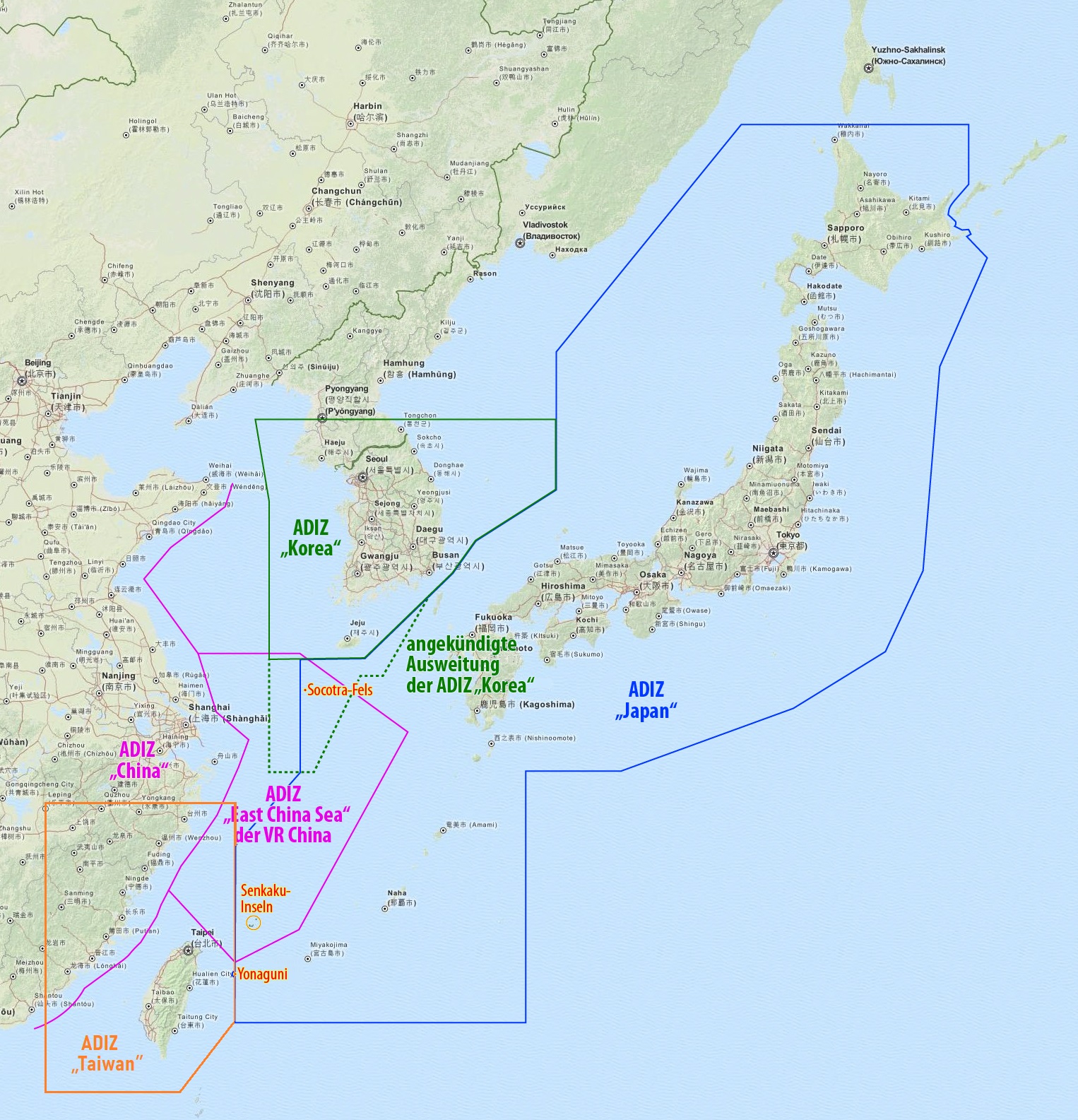
Is there a legend for that map? I'm not sure if I'm interpreting it correctly or not.. I see the box over Taiwan, but that extends over into the mainland. Do they really scramble jets in cases where Chinese fighters don't even go over the water? Or is that line that goes over the water the start of what they consider to be their airspace?
I don't think they scramble jets on Taiwan, no. But every time a news report comes out about Chinese jets representing escalating aggression towards Taiwan, that is the boundary they are actually talking about.
> … or there will be military action to bring Taiwan in line.
I don't see how this won't cause further escalation… perhaps just one ohio class authorized to target up to 288 civilian and military installations needed to "bring Taiwan in line"…
What other escalation would there be if the ccp invades and installs a new government or just makes it part of China?
I think that would be game over for Taiwan and the only blowback on China would be sanctions. It would go over exactly like what happened with Russia in the Ukraine. Everyone would be pissed at China but no one would want to start ww3.
Perhaps an ohio class sub can be leased (crew and all) to the ROC and under direct command of the civilian leadership…
Of course none of this has to be made public with the proper FISA authorizations…
In such a scenario the PRC is the one starting ww3, but perhaps not if the ROC goes public and states that its simply defending itself… if NK can get away with it, I don't see why any other nation state cannot pursue the same strategy…
PRC would know something like this is in place when the ROC no longer decides to scramble the fighters as much :P
And yes, invading Taiwan after China took over is an option, but I don't see how it's possible that option would be chosen. Engaging another super power like China is extremely dangerous and would lead to a massive conflict. Our carrier strike groups are mighty, but they would be overwhelmed by anti ship missiles very quickly. If the United States were serious about defending Taiwan in a conflict, we would have troops in Taiwan as a deterrent like we do with other countries in the region.
China currently gets most of its iron ore from Australia. It is completely unworkable to transport that by air as are many other things. (If China had to for example transport petroleum from the Persian Gulf by air, my guess is that it would cost more petroleum to fuel the operation than the operation would move. ISTR that most of the cargo by weight transiting the oceans is petroleum.) A naval blockade would harm China more than conquering Taiwan would help China.
> A naval blockade would harm China more than conquering Taiwan would help China
Agreed. And not just iron ore, military and civ populations need to be fed:
There's also the fact that most of China soybean supply comes from imports (around 90 percent of its soybeans are imported from the international market and are mostly used in oil and animal feed)… China would have to be able to deploy/resupply some sort of protection for those ships for any cargo imported.
There's lots of different avenues that can be pursued by a varying number of state/non state actors, that will have varying levels of impact and feasible response to such, so I really find the thinking "ww3 is highly unlikely so, [x] actor/nation state can do w/e it wants with no material consequences" really lazy…
HK is de jure and de facto part of China and subject to its rule, and although China allows some amount of self-governance, national security issues (as tapping a submarine cable would be) are within mainland control.
Taiwan is more complicated; it may be de jure part of China, but there are two governments that de facto govern distinct territories.
Taiwan's not in the middle of being taken over by the mainland chinese government, and it's also not a location data would go through to reach other countries.
They may not be in the middle of being taken over, but the process has definitely started. Ccp jets are being flown into Taiwanese airspace constantly. I don't think China would risk looking weak by backing down and letting Taiwan be free.
And so to I doin't think (or minimally hope) that the US and democratic coalitions would risk looking weak by backing down and letting CCP call a bluff and thus ending our hegemony.
I'm not sure the fact that it's been going on for years makes it any less serious. It's an act of intimidation that is designed to drain the defense budget of Taiwan ([1]) while desensitizing and normalizing these incursions into Taiwanese air space. The carrots that the CCP are offering aren't very appetizing, but the way that they are wielding this massive sledgehammer of a stick forces Taiwan to stay at the negotiation table. There is nothing like what is happening there anywhere else in the world right now. There is a reason that they have spent billions of dollars on air defenses, they are rightfully terrified. China has made their intentions clear, they own Taiwan and they will bring them back into the fold one way or another.
Negotiating for what? Taiwan is not giving up its democracy.
China is doing similar things to other SEA nations with their island building, and they do incursions on Japan for sure.
Expect the nature of the situation to change in the next ten years as these systems become more automated. Why become fatigued when your F-16s fly themselves.
Yea, exactly, it's bs. I really hope they can hold out and maintain a true democracy but Taiwan is one of the biggest priorities for the CCP, they are putting billions of dollars into bringing Taiwan back into the fold. I think they would probably like to avoid an armed conflict if at all possible, there is too much risk that it could go sideways and taking over a war torn Taiwan is not ideal. Ideally, they want to use clandestine means to accomplish their goals to maintain plausible deniability and have a low risk for blowback (e.g. using alleged kompromat playbook with the current Indonesian president, and alleged control of Hong Kong government officials).
If their intelligence services aren't successful in Taiwan, I don't put it past the CCP to invade and install a puppet. Russia has proven that no one wants world War 3. If they were to avoid a protracted engagement in Taiwan, I just don't see the United States risking attacking ccp forces when coming to the aid of Taiwan.
You don't consider there to be marked change between the last few years and the previous 20? in law, application of authoritarian power, and crackdown on speech and democracy movements?
The change in law is not especially great. The change in exercise of power is bigger.
Crackdown on speech and democracy movements? If in one year, there are no protest movements and no crackdowns, and in a later year there are several protests and several crackdowns, has the level of cracking-down-on-protests gone up?
Both yes and I feel like you are purposefully ignoring recent events.
In recent history, there were record breaking, HUGE protests of thousands and thousands HKers with umbrellas, at first marching mostly unhindered and somewhat successful in at least postponing the illusion of democratic law.
The situation in Taiwan for human rights, freedom of the press, freedom of speech and government non-interference of the Internet is radically different than in mainland china.
The US doesn't operate a great firewall. I don't dispute the capabilities that the NSA, CSE, GCHQ/five eyes partners have, or presently operate, but what matters to me is the results in human rights abuses, freedom of the press and freedom of speech abuses, arbitrary detention, and censorship of the Internet that results from it.
If I had to make the purely pragmatic lesser of two evils choice between the US domestic telecom system as it's run right now (day job is senior network engineer for an ISP), and how telecom is done in China, I'll take the US/NATO approach any day of the week. I don't have time to go into great detail without violating a whole boatload of NDAs and other restrictions, but to use a crude metaphor, suffice to say that I've seen how the sausage is made.
Also if I may point out, a low effort comment engaging in nothing but "whataboutism" is barely a step above flamebait.
Well there's no whataboutism when the US block us (Im in HK) from a peering connection because they re scared we ll betray their precious secrets to our chinese overlord while frankly, when we took Snowden, they didn't make it easy either. And that was way more important for national security and freedom to protect americans against the NSA outreach. I mean, it's annoying that when we point the absurd contradiction of the US claims, we get turned down to whataboutism.
For Americans, freedom and security only matter when it apply to their own economical interests (rarely their oppressed citizens), which is fine, but you cant claim you d prefer NATO to the China model: they are both exactly the same from the point of view of someone a external...
Whether you're american or chinese doing the right thing when the State does the wrong thing, lands you in jail after monitoring turned you to secret services. The diff may be the US State does less wrong things, and that jail in the US is a bit better, but you know... you still cant do the right thing when needed so a cable or not with Hong Kong, what exactly are they trying to protect...
The US and PRC are not exactly the same in terms of where freedom and security matter.
Maybe i'm not understanding what you wrote, but are there any recent examples of US 'monitoring' our own citizens, and then turning them into (whatever our form of) secret services? besides criminal behavior?
from my reading you imply that someone 'doing the right thing' like speaking out against for instance the overreach of our government - like i'm decrying right now - could land a US citizen in some Xinjiang-like interment camp for 're-education.'
prima face ridiculous comparison. so it goes with every CCP thread that spirals with attempts to distract and deflect. And hey maybe it works since I always seem to get sucked in.
and how is the overreach snowden revealed comparable to the active (as opposed to passive dragnet surveillance), constant, oppressive digital intervention of CCP in the lives of its citizens, let alone the gross misuse of tracking technology to perpetrate an ongoing genocide?